
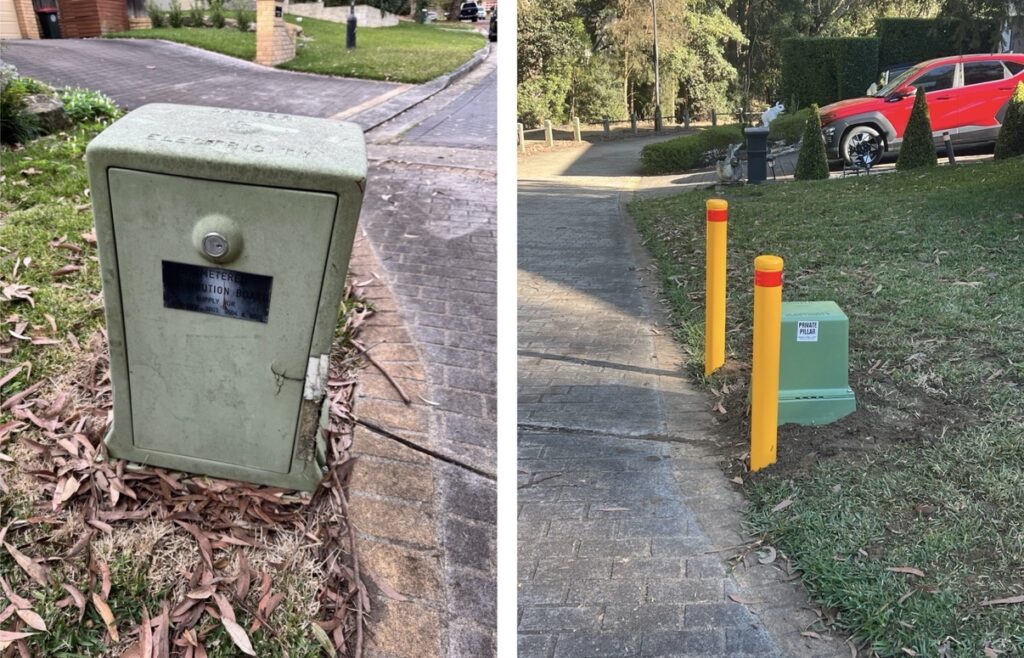
If you’ve got a metal pillar box near the end of your driveway, that’s your private electrical pillar — the point where the underground supply from the street connects to your home’s switchboard. It’s not decorative, and it’s not council property. It’s yours to maintain, and a damaged one can knock out power to the whole house.
We were recently on a job in Castle Hill replacing exactly this. The homeowner’s pillar sat right on the edge of the driveway, close enough that a reversing car or a wide trailer only had to clip it once. It hadn’t been hit badly enough to cause an outage yet — but the casing was cracked, and a cracked pillar is a matter of when, not if.
What a private electrical pillar actually does
A private pillar houses the connection between the underground supply cable from the street and the metering equipment for your property. In the Hills District, most homes built from the 1980s onward on larger blocks have one, usually positioned near the driveway entrance because that’s where the underground run from the street meets the property boundary.
Because it sits at ground level near a driveway, it’s exposed to exactly the kind of impact a switchboard on a wall never sees — car doors, trailer tow bars, ride-on mowers, bins being wheeled past. Most of the private pillar failures we see aren’t from age. They’re from a knock that cracked the casing months or years before the fault actually showed up.
Why we started fitting bollards as standard
Replacing a damaged pillar and leaving it exactly as exposed as the one that just failed doesn’t make sense. On the Castle Hill job, we installed steel bollards around the new pillar in the same visit — a five-minute addition to a job we were already doing, for a homeowner who won’t be back in twelve months with the same problem.
This isn’t standard practice across the industry. Most replacements go back in exactly where the old one was, with no protection added, because the job brief is “replace the pillar,” not “stop this happening again.” We think that’s a gap. If you’re paying for a private pillar replacement, protecting the investment costs almost nothing extra when it’s done as part of the same call-out.
Signs your private pillar needs attention
- Visible cracks or damage to the casing
- The pillar sits within reach of a driveway, garage entry, or turning circle
- You’ve noticed flickering power or nuisance trips with no other obvious cause
- The property was built before 2000 and the pillar has never been inspected
If any of these apply, it’s worth having a licensed electrician check it before it becomes an unplanned outage.
FAQ
What is a private electrical pillar?
A private electrical pillar is the above-ground enclosure on a residential property that houses the connection point between the underground electricity supply from the street and the property’s metering and switchboard. It’s owned and maintained by the homeowner, not the local network provider.
Can a cracked electrical pillar cause a power outage?
Yes. A cracked or damaged pillar casing can allow moisture or debris into the connection point, which can cause nuisance tripping or a complete loss of power to the property, and in some cases creates a safety hazard requiring immediate attention.
Do I need bollards around my electrical pillar?
If your pillar is located near a driveway, garage entrance, or anywhere a vehicle could reasonably reverse or turn near it, bollards are a low-cost way to prevent impact damage that would otherwise require a full pillar replacement.
Who is responsible for maintaining a private electrical pillar?
The property owner is responsible for the private pillar and the wiring on their side of the connection point, distinct from the network provider’s infrastructure on the street side.
Saunders Electrical Group is a licensed residential electrician (NSW Electrical Contractor Licence 344815C) servicing the Hills District and Hawkesbury region, including Castle Hill, Kenthurst, Baulkham Hills, and surrounding suburbs.