
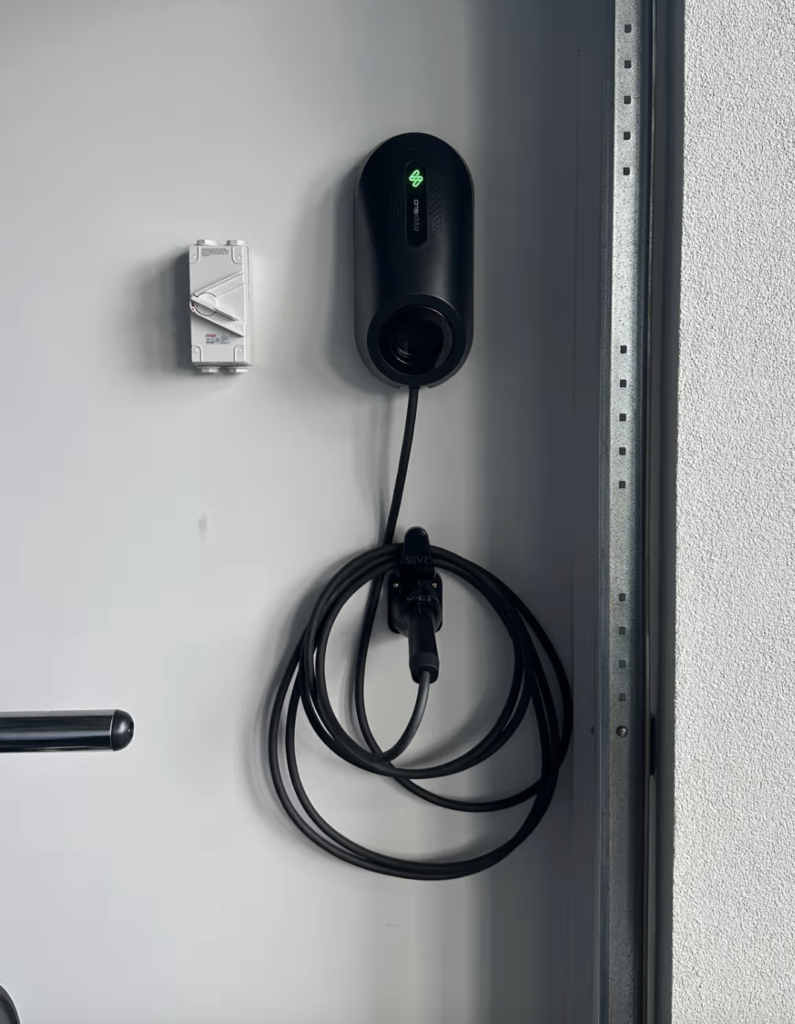
If you drive a Tesla and have rooftop solar but no Powerwall, the Tesla Wall Connector can’t charge your car from surplus solar on its own. The myenergi zappi GLO can. In September 2026, Saunders Electrical Group installed one of the first zappi GLOs in the Hills District, in Box Hill, for a Tesla owner who wanted exactly that. It was supplied and installed for $1,830+GST on a dedicated 32A single-phase circuit.
Below is why we recommended the GLO over the Wall Connector, exactly how the job was installed to AS/NZS 3000:2018, what it cost, and who the GLO is (and isn’t) the right charger for.
The Box Hill job at a glance
- Location: Box Hill, NSW (Hills District)
- Vehicle: Tesla
- Charger: myenergi zappi GLO, 7kW single-phase, 6.5m tethered Type 2 cable
- Circuit: Dedicated 32A single-phase circuit, protected by a Hager Type A RCBO
- Solar integration: CT clamp on the incoming mains
- Mounting: Inside the garage, back-to-back with the switchboard
- Extras: Type 2 cable and plug holder bracket
- Price: $1,830+GST supply and installation (bracket additional)
Why not the Tesla Wall Connector?
Most Tesla owners assume the Wall Connector is the obvious choice. It’s a well-built charger, but on its own it charges at whatever rate the car asks for. It has no idea what your solar panels are doing.
Tesla’s own solar-matching feature, Charge on Solar, only works if you also own a Tesla Powerwall. The Wall Connector also doesn’t support OCPP, the open protocol most third-party solar and battery systems use to control a charger. Without a Powerwall, a Wall Connector on a solar home is effectively a dumb charger. By day it pulls from the grid whenever your panels can’t cover the car and the house together.
There are workarounds. Apps such as Charge HQ can throttle a Tesla’s charge rate through the car’s own software, but solar charging on Charge HQ is a paid subscription and depends on your inverter brand being supported.
The zappi GLO takes the simpler route: the solar sensing lives in the charger itself. A CT clamp on the incoming mains tells it, in real time, whether the house is importing from or exporting to the grid. The GLO then adjusts its charge rate so surplus solar goes into the car instead of being sold back for a few cents per kWh. There’s no battery, no subscription and no reliance on the car maker’s app. Australian-delivered Teslas use a Type 2 inlet, so the GLO’s tethered cable plugs straight in with no adaptor.
The Wall Connector still makes sense if you don’t have solar, or if you already own a Powerwall and can use Charge on Solar. If you have a non-Tesla home battery as well as solar, the choice gets more involved. See our Kellyville Tesla Gen 3 vs Zappi case study, where a Fox ESS battery changed our recommendation.
What the zappi GLO is, and what changed from the zappi 2
myenergi released the zappi GLO in Australia in mid-2026. It sits alongside the zappi 2 rather than replacing it, and it’s the budget-friendly way into myenergi’s solar charging. The main differences:
- No screen or buttons. Everything is set up and controlled in the myenergi app.
- Much slimmer. It’s 170mm wide against the zappi 2’s 282mm, which makes it easier to fit on a garage wall between a car and a door frame.
- One smart charging toggle instead of Eco and Eco+. With smart charging on, the GLO uses surplus solar, follows your schedule and responds to tariffs. If you’ve read our zappi charging modes explainer, note that the Eco and Eco+ modes described there don’t exist on the GLO.
- RFID tap-to-charge for up to 126 users, useful for households with more than one EV.
- Built-in 6mA DC fault protection, which matters for compliance (more below).
The honest trade-off: owners who liked fine-tuning between Eco and Eco+ on the zappi 2 get less manual control. For most households, a single toggle is the point.
How we installed it
Dedicated 32A circuit, Type A RCBO and DC fault protection
AS/NZS 3000:2018 Appendix P requires every EV charging point to have its own dedicated circuit and its own RCD rated at 30mA, of at least Type A. For chargers using Type 2 connectors, the standard requires either a Type B RCD, or a Type A RCD combined with DC fault detection that disconnects above 6mA DC. The GLO has that 6mA DC protection built in, so a Hager Type A RCBO at the switchboard meets the requirement without the extra cost of a Type B device.
Mounted back-to-back with the switchboard
The charger went on the garage side of the same wall as the switchboard. That gives the shortest possible cable run: less cable, lower voltage drop, no cable pulled through ceilings or cladding, and almost no disruption inside the home. When a customer’s switchboard location allows it, this is the cleanest install there is.
Inside the garage, out of the heat
The GLO is IP65-rated, so it can legally go outside, but that doesn’t make outside the best spot. myenergi’s zappi chargers list a maximum operating temperature of 40°C. Box Hill and the rest of north-west Sydney regularly see 40°C+ days, and a charger on a west-facing wall in direct afternoon sun runs hotter than the air around it. Inside the garage, this unit stays shaded, cooler and physically secured.
CT clamp on the incoming mains
Solar charging is only as good as what the charger can see. The CT clamp has to measure the whole home’s connection to the grid, so it goes on the incoming mains. If it’s placed on the wrong cable, the GLO misreads the surplus and either wastes solar or pulls from the grid when it shouldn’t. Leave it out entirely and the charger can’t see the solar at all. We’ve been called back to fix exactly that, which you can read about in why the cheapest EV charger quote isn’t always right.
A cable holder bracket, not a cable wrap
The GLO’s 6.5m tethered cable is heavy. Wrapping it around the charger itself, which is what most people do, hangs that weight off the unit and its wall fixings every day. We fitted a Type 2 cable and plug holder bracket so the cable and connector are stored separately, off the floor, with no load on the charger.
“He wanted a budget-friendly EV charger that was still a smart charger and would integrate with his existing solar setup. That’s why I recommended the GLO.”
Oliver Saunders, Director and licensed electrician, Saunders Electrical Group
What a zappi GLO installation costs
This Box Hill job was $1,830+GST for supply and installation of the zappi GLO on a dedicated 32A circuit with a Hager Type A RCBO and a CT clamp on the incoming mains. The cable holder bracket was additional.
Two things push the price up:
- Distance from the switchboard. A charger at the far end of a double garage, or in a detached garage, needs a longer cable run than a back-to-back install.
- Switchboard condition. Around one in ten Hills District EV charger jobs we quote needs a switchboard upgrade first, typically an additional $1,500 to $3,000+GST. Our EV charger installation requirements guide explains how to tell whether yours will.
The charger carries a 3-year manufacturer warranty, and every SEG installation is covered by our lifetime workmanship guarantee.
Is the zappi GLO right for your home?
It’s a strong fit if: you have rooftop solar and single-phase power, you want smart solar charging without paying for a screen you’ll rarely look at, or you have more than one EV and want RFID access control.
Look at something else if:
- You don’t have solar and don’t plan to add it. A simpler smart charger does overnight off-peak charging for less.
- You have three-phase power and want faster than 7kW. The GLO is single-phase only, so ask about the zappi multiphase.
- You already have a Tesla Powerwall. Tesla’s Charge on Solar may already cover you with a Wall Connector.
- Your garage has poor Wi-Fi. The GLO has no screen and relies on Wi-Fi or Bluetooth for control, so sort out coverage first.
If the GLO isn’t the right fit, our buyer’s guide What EV Charger Should I Buy? matches chargers to your car, your solar and your battery setup.
Zappi GLO FAQs
Can a zappi GLO charge a Tesla from solar without a Powerwall?
Yes. The zappi GLO reads household import and export through a CT clamp on the incoming mains and adjusts its charge rate to use surplus solar. It works with any Australian Tesla through the Type 2 inlet, with no Powerwall or subscription needed.
How much does it cost to install a zappi GLO in Sydney?
Saunders Electrical Group installed a zappi GLO in Box Hill for $1,830+GST, including supply, a dedicated 32A circuit, a Type A RCBO and a CT clamp. Longer cable runs or a required switchboard upgrade ($1,500 to $3,000+GST) add to that.
Does a zappi GLO need a Type B RCD?
No. AS/NZS 3000:2018 Appendix P allows a Type A RCD combined with DC fault detection that trips above 6mA DC. The zappi GLO has 6mA DC fault protection built in, so a Type A RCBO is compliant.
What’s the difference between the zappi GLO and the zappi 2?
The zappi GLO has no screen and is controlled entirely through the myenergi app, is 170mm wide against the zappi 2’s 282mm, and replaces the Eco and Eco+ modes with a single smart charging toggle. It is single-phase only and adds RFID tap-to-charge.
Can a zappi GLO be installed outside?
Yes, the zappi GLO is IP65-rated for outdoor use. In north-west Sydney, Saunders Electrical Group recommends a shaded or garage location, because zappi chargers list a 40°C maximum operating temperature.
Further reading
- EV charger installation in the Hills District
- What EV charger should I buy? Match it to your car and your solar
- Case study: Tesla Gen 3 vs Zappi EV charger, Kellyville
- Why the cheapest EV charger quote isn’t always right
- myenergi zappi charging modes explained
- EV charger installation requirements
- How long does EV charger installation take?
- Switchboard upgrades
Saunders Electrical Group is a myenergi certified installer and licensed electrical contractor (Licence 344815C), installing EV chargers across Box Hill, Rouse Hill, Kellyville, Castle Hill and the wider Hills District and Hawkesbury. Get a quote for your EV charger installation.