
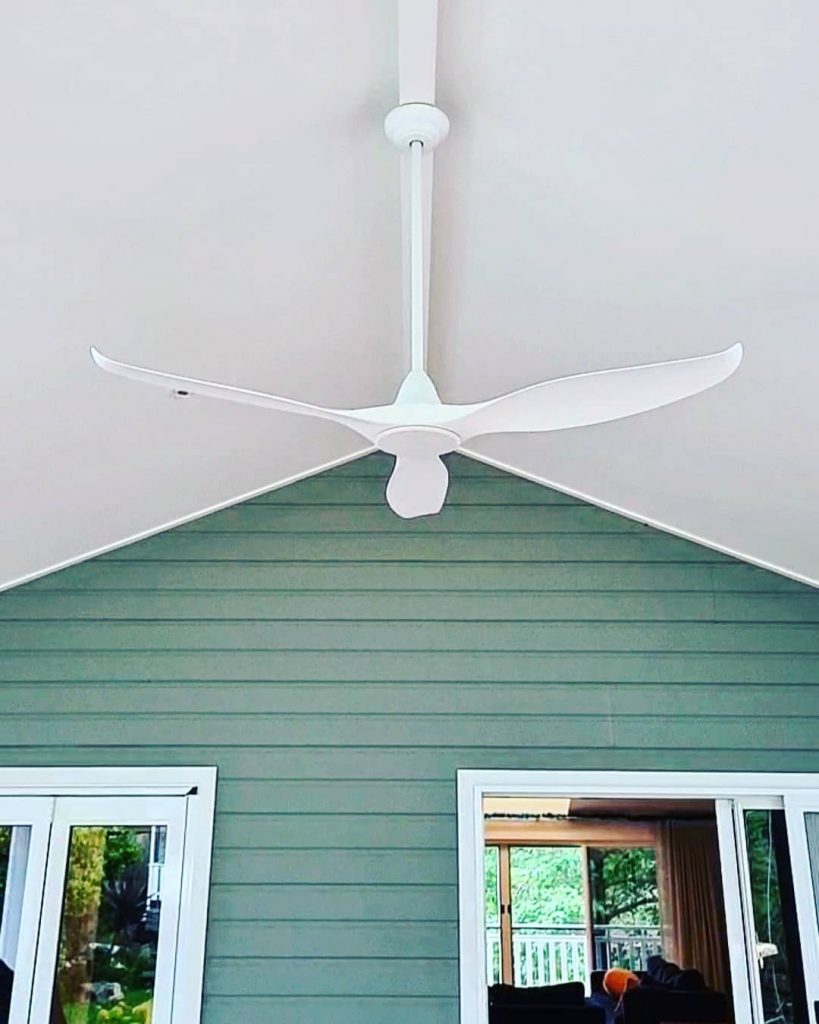
DC vs AC Ceiling Fans: What Actually Matters (Not What the Fan Shops Tell You)
About 9 in 10 ceiling fans we install or replace across the Hills District and Hawkesbury are now DC motor units. But if you’ve been reading up on DC vs AC before you buy, you’ve probably only seen the retailer version of this comparison — energy use, noise, speed settings. What actually shows up in your installation quote has less to do with the motor and more to do with requirements that apply to every ceiling fan, DC or AC.
The Quick Answer
Go DC if the fan’s going in a bedroom or anywhere noise matters — DC motors are meaningfully quieter, which is the main reason we now install them in the vast majority of jobs. AC still makes sense for a straightforward, budget-driven swap in a low-use space like a garage or rental where noise isn’t a factor.
First, a Correction: Licensing Has Nothing to Do With Motor Type
Some of what’s written online about DC vs AC fans suggests AC units are the easier, more DIY-friendly option. In NSW, that distinction doesn’t exist. Ceiling fan installation — AC or DC — is electrical work under AS/NZS 3000:2018, and it must be carried out by a licensed electrician regardless of which motor the fan uses. The “DIY-friendly” framing on some lighting retailer sites is inaccurate for this market, and doing it yourself risks a non-compliant job with no Certificate of Compliance behind it.
What Actually Shows Up in Your Quote: Manufacturer Requirements
This is the part the fan shops don’t mention, because it’s not about which fan you buy — it’s a fixed requirement for every ceiling fan installation. See our full Ceiling Fan Installation Requirements page for the complete breakdown of what’s legally required versus manufacturer-required:
- An isolating switch per fan. Every manufacturer’s installation instructions require a dedicated isolating switch for each fan installed. If you’re adding fans to a home that doesn’t already have one wired in per point, that’s a line item in the quote — not an upsell, a requirement.
- Minimum 2.1m floor-to-blade clearance. Standard across manufacturer instructions. In rooms with lower ceilings, this can rule out a full-size fan altogether or push you toward a low-profile or hugger-style model.
- Minimum 300mm blade-to-wall clearance. Also a fixed manufacturer requirement, and one that catches out fans planned for tight corners, sloped ceilings, or rooms with built-in wardrobes close to the ceiling line.
None of these change based on DC vs AC. They’re the actual constraints that decide whether a fan can go where a homeowner wants it, and they’re worth checking before you fall in love with a particular model online.
Why DC Wins for Bedrooms Specifically
DC motors run noticeably quieter than AC at comparable airflow, which matters far more in a bedroom than a living area — it’s the difference between a fan you forget is running and one that’s audible at low speed with the lights off. That’s the main reason the ratio has shifted so heavily toward DC in bedroom installs specifically, more than the running-cost saving.
When AC Still Makes Sense
A straight AC swap on an existing point, in a garage, rental, or low-use space where noise and running cost aren’t priorities, is still a faster, cheaper job. There’s no installer-side reason to insist on DC everywhere.
What We’re Actually Seeing On Site
Roughly 9 in 10 fans we install or replace across the Hills District and Hawkesbury now are DC — most homeowners replacing ageing AC units room by room rather than doing a whole-home swap in one go (see our Dural whole-home upgrade case study for what that looks like when someone does commit to the full swap).
Frequently Asked Questions
Does every ceiling fan need its own isolating switch?
Yes. Manufacturer installation instructions require a dedicated isolating switch per fan. This is standard across brands and isn’t optional or model-specific.
How much ceiling height do I need for a fan?
Manufacturer instructions require a minimum 2.1m clearance from floor to blade. In rooms with lower ceilings, this may mean choosing a low-profile fan or ruling a standard fan out for that space.
How far does a ceiling fan need to be from a wall?
A minimum 300mm clearance from blade tip to any wall or fixed object, per manufacturer instructions. This is worth checking before choosing fan placement in a corner or near a sloped ceiling.
Can I install a ceiling fan myself in NSW?
No. Ceiling fan installation is licensed electrical work in NSW regardless of motor type. An unlicensed install isn’t covered by home insurance if something goes wrong, and won’t carry a Certificate of Compliance.
Ceiling fan installation across the Hills District and Hawkesbury, from $160 + GST per fan. Every job includes a Certificate of Compliance and our lifetime workmanship guarantee. Call 1300 993 560 or see full pricing and suburb coverage.
Related: Ceiling Fan Buying & Installation Guide · Ceiling Fan Installation Requirements · Ceiling Fan Installation FAQ