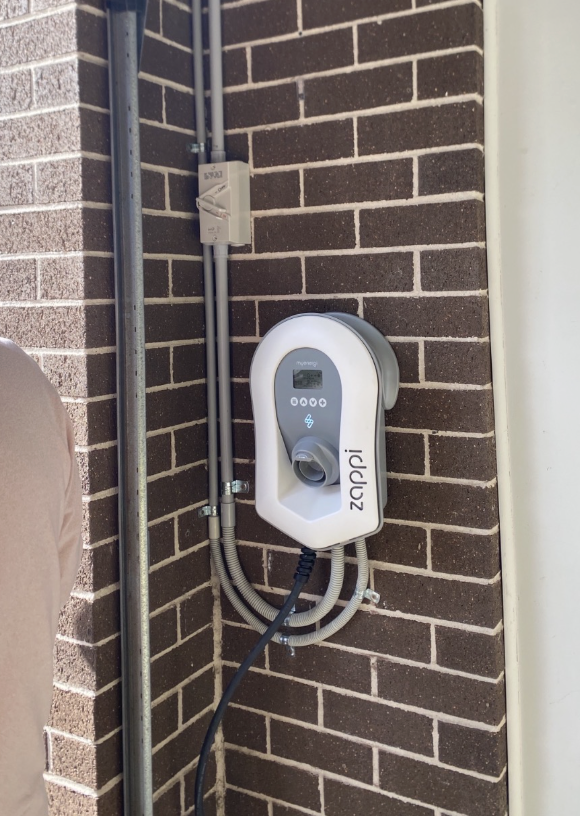
If your myenergi Zappi has been sitting on the same charging mode since installation day, there’s a good chance it’s the wrong one for how you actually use your car. As a Myenergi certified installer working across Kenthurst, Castle Hill and the Hills District, we see the same pattern on almost every service call: the homeowner picked whatever mode the installer left it on, and nobody’s touched it since.
The Zappi has four charging modes — Eco, Eco+, Fast, and Boost — and each one trades off speed against solar usage in a different way. Here’s how to work out which one actually suits your household, not just what the manual says each one does.
The four Zappi modes, in plain terms
- Fast — charges at full power from the grid, ignoring solar entirely. Fastest option, but you’re paying grid rates for all of it.
- Eco — blends grid and solar power, topping up from the grid whenever your solar output alone isn’t enough to maintain a steady charge.
- Eco+ — charges only from surplus solar. If there’s no excess solar being generated, charging pauses. Slowest, but close to free when it works.
- Boost — a manual override that forces a full-power charge for a set time or energy amount, regardless of mode. Useful for a one-off top-up before a long trip.
Why Eco+ isn’t automatically the “best” setting
Eco+ gets sold as the money-saving mode, and it is — if your solar system is sized for it and your car is home during daylight hours. But we regularly install Zappis for households where the car leaves the driveway by 7am and doesn’t return until after dark. In that situation, Eco+ can leave a car sitting at 40% charge for days, because there’s simply no solar surplus available while the car’s home to use it.
The households who get the most out of a Zappi are the ones who match the mode to their actual routine, not the default setting:
- Home during the day, decent-sized solar system (6.6kW+): Eco+ genuinely works — this is the household it was designed for.
- Away most of the day, charging overnight or on a time-of-use plan: Fast mode during off-peak hours will usually beat Eco+, because there’s no solar available overnight anyway.
- Mixed routine, weekday commuter but home weekends: Eco mode is the practical middle ground — it won’t stall the charge but still uses solar when it’s there.
- Unexpected long trip tomorrow: Boost, once, then back to whatever mode normally suits the house. Boost isn’t a setting to live on — it’s an override.
The mistake we see most often on service calls isn’t a faulty unit — it’s a household stuck on Eco+ with a driving pattern that never gives it enough solar to work with, wondering why the car never charges past half full.
Basic care: what actually needs doing
The Zappi is a low-maintenance unit, but a few things matter:
- Keep the tethered cable holstered when not in use — leaving it coiled on the ground invites water pooling in the connector and unnecessary cable wear.
- Don’t pressure-wash it. It’s outdoor-rated (IP65), but a hose on a gentle setting for the housing is fine — a pressure washer is not.
- Let firmware updates run. Myenergi pushes updates via the app periodically — these often improve solar diversion accuracy, so don’t dismiss the prompt.
- Check the app after a power outage. The Zappi usually resumes its last mode automatically, but it’s worth a quick check — we occasionally get calls where a mode reset to Fast after an outage and the homeowner didn’t notice until the next bill.
Considering a Zappi and not sure it’s the right charger?
The mode question above matters before you buy, too — if your household is rarely home during daylight hours, a cheaper Level 2 charger without solar diversion may suit you just as well as a Zappi, and there’s no point paying for smart features you won’t use. Worth discussing honestly with whoever quotes your installation.
It’s also worth knowing that mode selection assumes the Zappi was actually configured correctly in the first place. See why the cheapest EV charger quote isn’t always right for a real example of a Zappi that couldn’t see solar at all because it was missing the CT metering clamps needed for any of these modes to work.
See our North Richmond Zappi installation case study for a real example of sizing a charger to a household’s solar and driving pattern, visit our EV Charger Installation page for pricing and what’s involved, or check our EV Charger Installation FAQ for the questions most Hills District homeowners ask before buying.
Frequently asked questions
Which Zappi mode saves the most money?
Eco+ saves the most per kWh when it works, but only if your solar system produces enough surplus while your car is home to charge. For many households, Eco mode ends up cheaper overall because it actually completes the charge instead of stalling.
Can I change Zappi modes myself?
Yes — modes are changed via the myenergi app or the touchscreen on the unit itself, and can be switched at any time without an electrician.
Does Boost mode use solar?
No. Boost overrides solar diversion and charges at full power from the grid for the set duration or energy amount you choose, then reverts to your previous mode.
Is it bad to leave a Zappi in Fast mode permanently?
Not for the unit itself, but you’ll be paying full grid rate for every charge and getting no benefit from any solar you have installed — it only makes sense if you’re on a genuinely cheap overnight tariff or have no solar system.
Electrical Contractor Licence 344815C.