
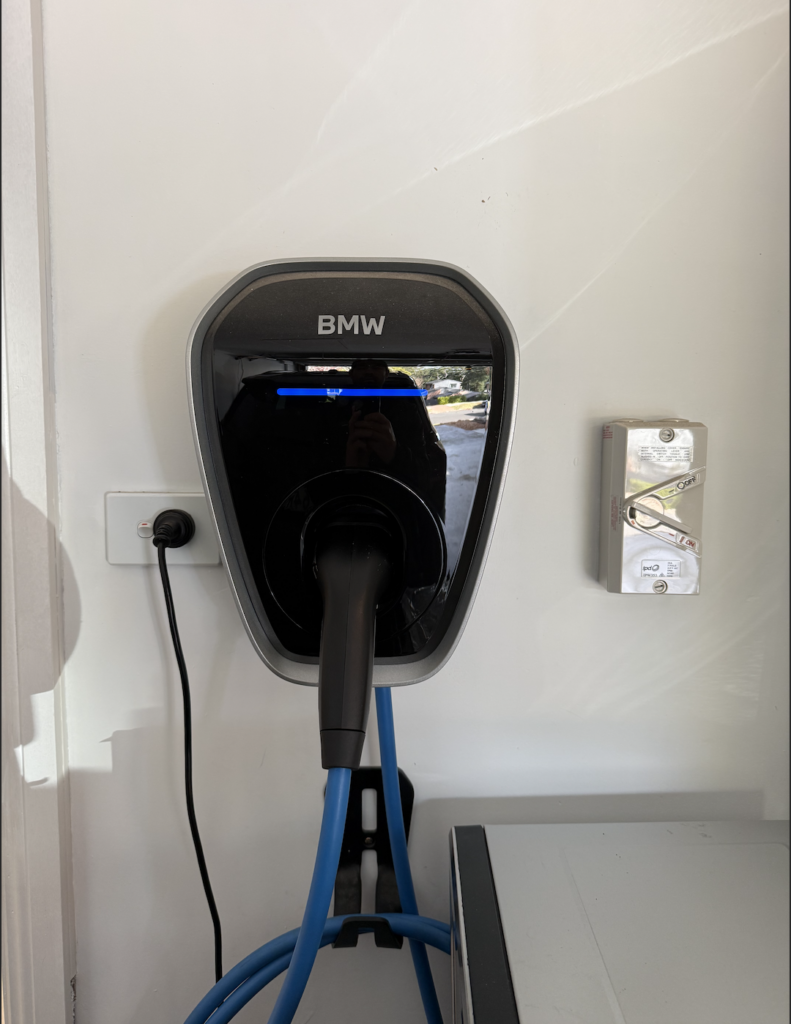
Buying an EV and wondering what a home charger install actually involves? Saunders Electrical Group installs EV chargers across Kenthurst, Castle Hill, Baulkham Hills, Rouse Hill, Windsor and Richmond, and these are the questions we get asked most before homeowners have even picked a car. Licensed under NSW Electrical Contractor Licence 344815C.
Can my home actually handle an EV charger without upgrades?
Most homes built after 2000 can support a 7kW single-phase charger without any electrical upgrades. Older homes — and this is common across established Hills District suburbs like Castle Hill and Baulkham Hills — often have switchboards that were never sized for an EV charger on top of ducted air conditioning, pool equipment, and modern kitchen loads, so a capacity assessment before you buy is worth doing rather than assuming.
Do I need a switchboard upgrade to install an EV charger?
Not always, but it’s one of the most common add-ons we quote alongside EV charger installs in the Hills District, particularly on properties built before the mid-2000s. A licensed electrician should assess your existing board capacity as part of any EV charger quote — if that’s not part of the quote you’re being given, ask why.
Single-phase or three-phase — which do I need?
Most EVs sold in Australia accept around 7kW on single-phase power, and buying a charger rated beyond what your car can actually take won’t charge it any faster. Three-phase (up to 11kW) matters more if you’re on a rural Hawkesbury property already running three-phase for other equipment, or if you’re future-proofing for a second EV.
What’s the difference between tethered and untethered chargers?
A tethered charger has a fixed cable built in, so it’s plug-and-go every night. An untethered charger uses a separate cable, which suits households running more than one EV or wanting a cleaner look on the wall — it costs a little more but adds flexibility.
My garage is detached, or I’m on acreage — does that change anything?
Yes, and this is where a lot of generic advice falls apart. On one recent North Richmond install, the charger needed a 28-metre cable run to a detached garage, which triggers voltage drop calculations that a standard attached-garage install never has to consider. If you’re on a larger Hawkesbury block, get this assessed before you commit to a charger location, not after.
How far does an EV charger need to be from a home battery?
At least 600 mm horizontally, and not within 900 mm above the battery. These clearances come from the restricted-location rules in AS/NZS 5139, which treat an EV charger as an appliance that isn’t part of the battery system. On a recent Box Hill install, the customer’s preferred spot fell inside that zone, so we mounted the zappi GLO about 650 mm from the battery instead. If you have a battery, tell your installer where it is before you choose a charger location. See how far an EV charger needs to be from a home battery for the full breakdown.
How much does EV charger installation cost?
It depends on the scope. A basic installation — switchboard ready, short cable run — runs $800–$1,200 + GST. A standard installation with a moderate cable run and minor switchboard work is $1,200–$1,800 + GST. Complex installations involving a long cable run or a full switchboard upgrade run $1,800–$3,500+ GST, and premium smart charger installs with solar integration and load balancing sit at $2,000–$4,000+ GST. We’ll tell you which tier your job falls into during the quote, not after.
If you’d like the cable kept off the garage floor, we also supply and install a wall-mounted cable and plug holder for $85 + GST. See where an EV cable holder goes and what it costs.
How long does the installation take?
Most standard single-phase installations take 2–4 hours on site. If a switchboard upgrade is needed, allow 4–8 hours, and more complex jobs — longer cable runs to a detached garage or shed — may need two visits. We’ll flag this during the quote rather than on the day.
What should I check before hiring an EV charger installer?
Confirm they hold a current electrical contractor licence — you can verify any NSW electrician’s licence through Fair Trading. An unlicensed or under-qualified install can void your vehicle warranty and may not be covered by home insurance if something goes wrong.
Is there a compliance issue most installers don’t mention?
The key detail is DC fault current protection. EV onboard chargers can produce a small, smooth DC leakage current that a standard Type A RCD isn’t designed to detect on its own — under AS/NZS 3000 Appendix P, that gap has to be closed either with an external Type B RCD, or a charger with its own built-in DC leakage detection (RDC-DD) working alongside a standard Type A RCD.
The chargers we install — Zappi (including the new zappi GLO), Evnex, Ocular, and Tesla’s Gen 3 Wall Connector — all include this built-in DC leakage detection as standard, which is why we can fit them with a Type A RCD on the switchboard rather than the more expensive external Type B unit, without compromising compliance. On our recent zappi GLO installation in Box Hill, for example, that meant a Hager Type A RCBO on a dedicated 32A circuit, paired with the charger’s built-in 6mA DC fault protection. What we always do is confirm and document which protection method applies to the specific charger going in, rather than assuming — not every brand on the market includes this feature, and it’s worth checking before you buy.
Further reading
- How Far an EV Charger Needs to Be From a Home Battery: A Box Hill Job Under AS/NZS 5139
- Where Should an EV Cable Holder Go? A Castle Hill Install, Priced
- Australia’s EV Tipping Point Just Arrived — Is Your Home Wiring Ready?
- EV Charger Installation Hills District
- EV Charger Installation Guide
- How Long Does EV Charger Installation Take?
- Zappi Charging Modes Explained
- Switchboard Capacity & EV Charger Compliance Requirements
- Case Study: Zappi GLO for a Tesla on Solar Without a Powerwall, Box Hill