
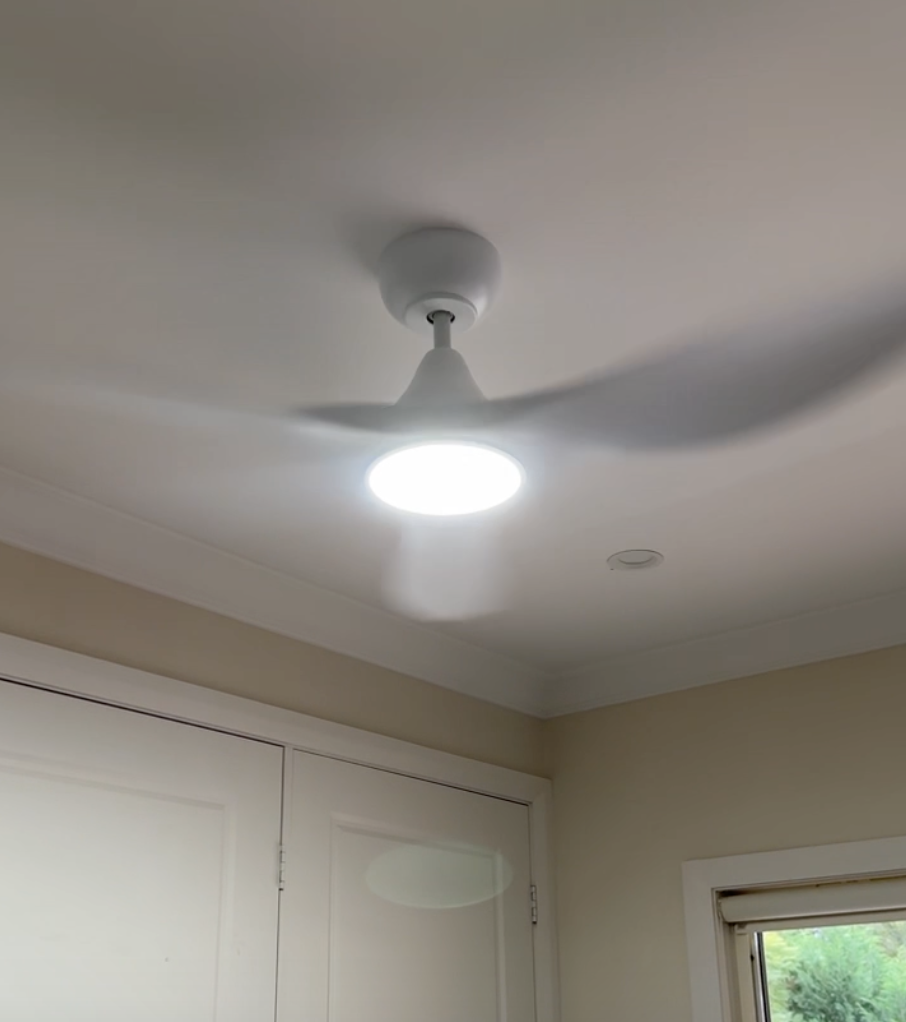
Most whole-home ceiling fan upgrades don’t start as whole-home projects — they start with one room. A Dural client had Saunders Electrical Group install a single Eglo Surf 48″ DC ceiling fan with LED light in their granny flat bedroom, replacing what had only ever been a downlight. A year later, that one fan was enough to convince them: they called us back to fit six more identical fans throughout the main house, each one replacing an ageing AC fan.
Why one fan is often the real test
Homeowners rarely decide to replace every ceiling fan in a house in a single call. It’s a bigger cost, a bigger disruption, and a bigger commitment to a fan they haven’t lived with yet. What we see far more often in the Hills District and Hawkesbury is exactly what happened in Dural: one room gets a new fan, usually somewhere lower-stakes like a granny flat or a spare bedroom, and if the homeowner likes how it looks, sounds, and performs, the rest of the house follows — sometimes months later, sometimes, as in this case, a full year on.
This matters for how to think about a first fan install. It’s not just solving one room’s problem. If it goes well, it’s the sample the rest of the house gets judged against.
What the Dural job involved
The first install replaced a single downlight in the granny flat bedroom with an Eglo Surf 48″ DC fan and integrated LED light — going from a light-only point to a fan point, which requires the correct fan-rated support and new switching, not just a fixture swap. The client was happy enough with it that when they called back, they asked for the exact same fan throughout the main house: six more Eglo Surf 48″ DC units, each replacing an existing, older AC motor fan.
Matching the fan model across every room wasn’t incidental — it’s a deliberate choice worth making when a client rebooks like this. One model means one remote or app ecosystem across the whole house instead of six different manuals, consistent blade span and finish from room to room, and a single spare-parts and warranty line if anything ever needs servicing. Six different fan models bought individually over time would have solved the same airflow problem but left the client managing six different products.
The ceiling fan work was one part of a full day on site — the same visit also covered Cat6A cabling for multiple wireless access point installations elsewhere in the property. Bundling electrical and data/communications work into one visit is common on larger residential jobs and Hills District acreage properties in particular, where a single callout covering several trades saves the client multiple site visits.
What to consider before converting a light to a fan
Converting an existing downlight or light point into a ceiling fan location isn’t a straight swap. The point needs to be assessed for whether it can take a fan-rated bracket and, where it can’t, upgraded accordingly — this is standard practice on any conversion job and part of what a licensed electrician checks before quoting. See our Ceiling Fan Buying & Installation Guide for how this scenario compares to a standard replacement or a raked-ceiling install. A Certificate of Compliance is issued regardless of whether the job is a straight fan replacement or a light-to-fan conversion.
Why AC-to-DC replacement is now the more common request
The Dural main house fans being replaced were all AC motor units, and this is increasingly the pattern we see: clients replacing older AC fans with DC models room by room, for lower running cost, quieter operation, and more speed settings. Roughly 9 in 10 ceiling fans we install or replace across the Hills District and Hawkesbury are now DC motor models. See our DC vs AC ceiling fan comparison for what actually drives that decision beyond running cost — including the manufacturer clearance and isolating switch requirements that apply to every fan, DC or AC.
Saunders Electrical Group installs ceiling fans across the Hills District and Hawkesbury, including granny flats, whole-home upgrades, and light-to-fan conversions. Every installation includes a Certificate of Compliance. Call 1300 993 560 for a fixed-price quote.
Related: Ceiling Fan Installation — Hills District & Hawkesbury · Ceiling Fan Buying & Installation Guide · Ceiling Fan Installation FAQ · DC vs AC Ceiling Fans: What Actually Matters · Why Your Ceiling Fan Wobbles — And Why It’s Rarely the Fan’s Fault
Frequently Asked Questions
Do I need to replace every ceiling fan in my house at the same time?
No. Most whole-home ceiling fan upgrades start with a single room. It’s common for a homeowner to trial one fan, then decide to match the rest of the house later once they’re confident in the model.
Can a downlight be converted into a ceiling fan point?
Yes, but it isn’t a straight swap. The existing point needs to be assessed for whether it can support a fan-rated bracket, and upgraded if it can’t. This is part of a licensed electrician’s standard assessment before quoting a light-to-fan conversion.
Does it matter if I use the same ceiling fan model throughout my house?
It’s not required, but it’s worth considering. Matching the model across every room means one remote or app system for the whole house, consistent appearance and blade span, and a single spare-parts and warranty line rather than managing several different products.
Can ceiling fan installation be combined with other electrical work in one visit?
Yes. Larger jobs, particularly on bigger Hills District properties, often combine ceiling fan installation with other work such as data cabling or network points in a single visit, reducing the number of separate callouts required.
Are most ceiling fans installed now DC or AC motor?
DC. Roughly 9 in 10 ceiling fans Saunders Electrical Group installs or replaces across the Hills District and Hawkesbury are now DC motor models, largely replacing older AC units.