
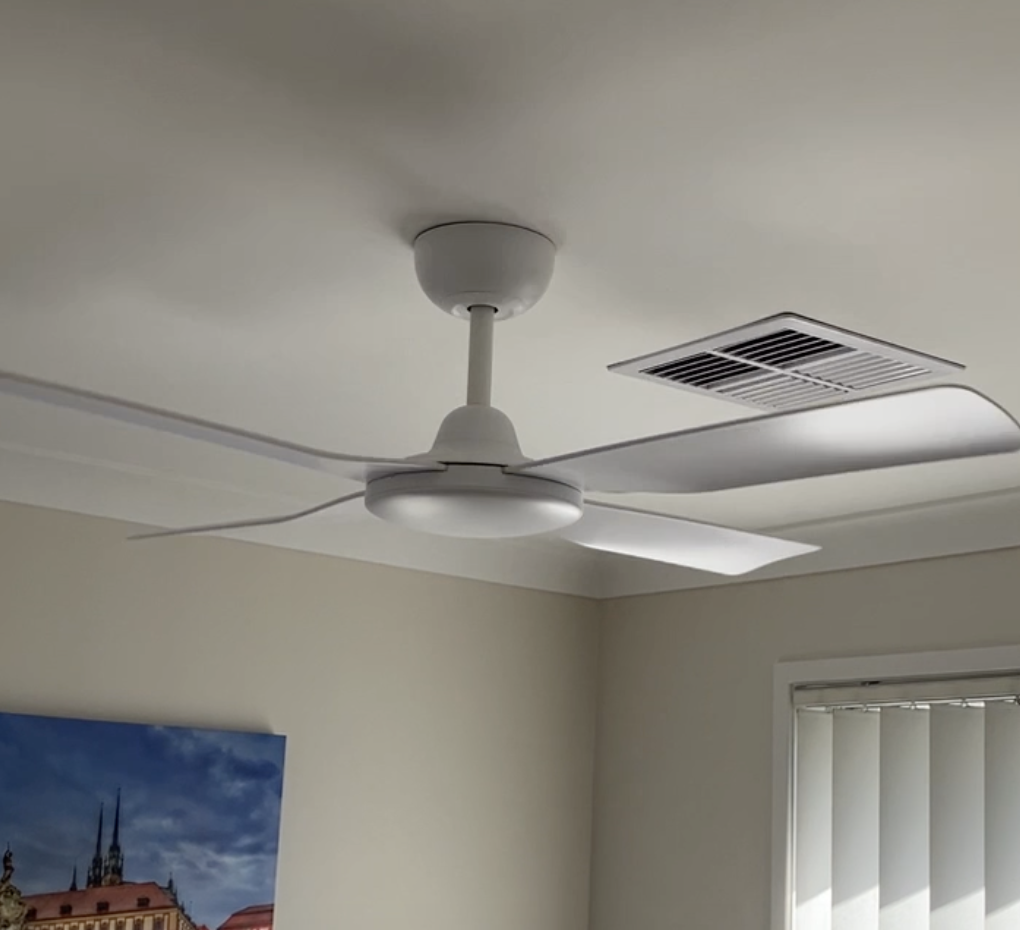
A wobbling ceiling fan is rarely a balance problem — it’s usually a support problem. Saunders Electrical Group (Licence 344815C) recently found this on a callout in Stanhope Gardens: a fan installed only months earlier was fixed to the plasterboard ceiling with standard wall anchors, with no timber blocking behind it to actually take the load. The other three fans in the same house had the identical fault.
Why a wobbling fan is a mounting issue, not a balance issue
Most advice on a wobbling ceiling fan starts with the blades — check they’re clean, check they’re level, tighten the screws. That’s the right first check for a fan that’s been running fine for years and has recently started wobbling. It’s the wrong first check for a fan that’s wobbled since it was installed, or one that was installed within the last one to two years.
A ceiling fan is a continuous dynamic load — the motor is spinning, and every rotation puts a small cyclical stress through the mounting point. A pendant light fitting is a static load — it just hangs there. Standard plasterboard ceiling anchors are rated for static loads. They are not designed to hold a fan-rated bracket against years of vibration, and over time they work loose in the gypsum board itself, which is what produces the wobble — independent of whether the fan blades are perfectly balanced. See our Ceiling Fan Buying & Installation Guide for how this fits into the bigger picture of what actually determines a proper install.
What we found in Stanhope Gardens
The customer called about one wobbling fan in a bedroom. When we took it down to inspect, the fan wasn’t fixed to a timber support in the roof cavity at all — it was held on standard wall/ceiling anchors screwed directly into the plasterboard, and those anchors were coming loose in the ceiling. We installed a timber block between the joists in the roof cavity, fixed the fan-rated bracket to that block, and re-hung the fan securely.
The house had three other ceiling fans in other bedrooms, installed at the same time by the same original installer. We checked all three while we were up there. None of them had timber blocking either. We fitted blocking and re-secured all four fans on the one visit. Timber blocking to correctly support a fan is $80 + GST per fan, supplied and installed — on this job, that meant fitting and re-securing all four fans in one visit rather than four separate callouts.
The customer had originally gone with the cheapest of several quotes for the initial installation. That’s not a coincidence we’re pointing out to be unkind about it — it’s the actual mechanism. Fixing a fan-rated bracket properly into a timber block takes more time on the tools than screwing straight into plasterboard. If a quote is priced assuming the fastest possible install, this is the step that gets skipped, and it’s invisible from the ground once the fan’s back up and spinning. It doesn’t show up as a fault for months, sometimes longer — until the anchors start to give.
Why this matters more than most people assume
A fan that’s marginally loose in the ceiling isn’t just an annoying wobble or a rattling noise at night. It’s a fixture with a spinning motor and blades held up by a fixing that’s degrading. Left long enough, that’s a fixture that can come down. This is exactly why NSW classifies ceiling fan installation as prescribed electrical work requiring a licensed contractor — the compliance requirement isn’t just about the wiring, it’s about the whole installation being done to a standard that holds up over years of actual use, not just on the day it’s switched on.
What to check if your fan feels loose
If a ceiling fan in your home wobbles, makes a knocking or grinding noise, or feels like it has slight play when you push gently on the downrod (fan off, at the switchboard), it’s worth having it inspected rather than just rebalancing the blades. This is especially relevant if:
- The fan was installed in the last one to three years
- You don’t know whether the original installer added timber blocking behind the bracket
- You have other fans installed at the same time by the same installer — as in the Stanhope Gardens job, a mounting shortcut on one fan usually means it was done the same way on all of them
Saunders Electrical Group inspects and re-secures ceiling fans across the Hills District and Hawkesbury, including checking and correcting inadequate mounting from a previous installation. Every job includes a Certificate of Compliance. Call 1300 993 560 for a fixed-price assessment.
Related: Ceiling Fan Installation — Hills District & Hawkesbury · Ceiling Fan Buying & Installation Guide · Ceiling Fan Installation FAQ · One Fan Became Seven: A Dural Whole-Home Ceiling Fan Upgrade
Frequently Asked Questions
Why does my ceiling fan wobble even after balancing the blades?
If blade balancing hasn’t fixed the wobble, the issue is very likely the mounting, not the fan. Fans are a continuous dynamic load and need a fan-rated bracket fixed to timber blocking in the roof cavity — a bracket screwed only into plasterboard or a standard ceiling anchor will work loose over time regardless of how well the blades are balanced.
Do all ceiling fan installations need timber blocking in the roof cavity?
Where there isn’t already a joist directly above the fixing point, yes — a timber block (noggin) needs to be fitted between the joists so the fan-rated bracket has solid timber to fix into. Skipping this step is a common shortcut on lower-priced installations and won’t show as a fault until the mounting works loose, often months later.
Can a cheap ceiling fan installation cause a wobble later on?
Yes. A rushed or underpriced installation is more likely to skip the timber blocking step because it takes longer to do properly than fixing straight into plasterboard. The wobble this causes typically doesn’t appear on day one — it develops as the inadequate fixing gradually loosens under the fan’s ongoing vibration.
If one ceiling fan in my house has this problem, do the others have it too?
Often, yes. If multiple fans were installed at the same time by the same installer, they were very likely mounted the same way. It’s worth having all fans from that installation checked at once rather than waiting for each one to develop a wobble separately.
How much does it cost to fix a poorly mounted ceiling fan?
Supply and installation of timber blocking to correctly support a ceiling fan is $80 + GST per fan, in addition to any labour for accessing the roof cavity. This is quoted as a fixed price before any work begins — no call-out fee, no hourly rate.