
Ceiling Fan Buying & Installation Guide — Hills District & Hawkesbury
Most ceiling fan quotes in the Hills District go wrong at the ceiling, not the fan. Homeowners spend their research time comparing DC vs AC, blade span, and brand — reasonable questions, but not the ones that decide whether your install is a straightforward $160 job or something that needs extra work quoted on the day. What actually determines cost and feasibility is what’s above your ceiling and what’s already there: a flat plasterboard ceiling, a raked or vaulted one, or an existing light point you’re converting to a fan.
The Real Decision: What’s Above the Ceiling, Not Which Fan You Buy
A ceiling fan is a continuous dynamic load — the motor’s always turning, and every rotation puts cyclical stress through the mounting point. That’s a completely different job to hanging a light fitting, which just sits there. Whichever fan you buy, the installation itself comes down to one of three scenarios, and each one changes what the job actually involves.
Scenario 1: Standard Flat Plasterboard Ceiling
This is the most common Hills District job. Plasterboard alone can’t take a fan’s ongoing vibration — the mounting bracket has to be fixed to a timber joist, or to a timber block (noggin) fitted between the joists if there isn’t already one directly above the fixing point. Skipping this step is the single most common shortcut on underpriced installs, because fixing into a solid block takes longer on the tools than screwing straight into plasterboard. It’s also invisible from the ground once the fan’s installed — it doesn’t show up as a fault for months, sometimes longer, until the fixing works loose. We’ve seen this exact fault across four fans in a single Stanhope Gardens property, all installed within the previous year. Timber blocking, supplied and installed, is $80 + GST per fan.
Scenario 2: Raked or Vaulted Ceiling
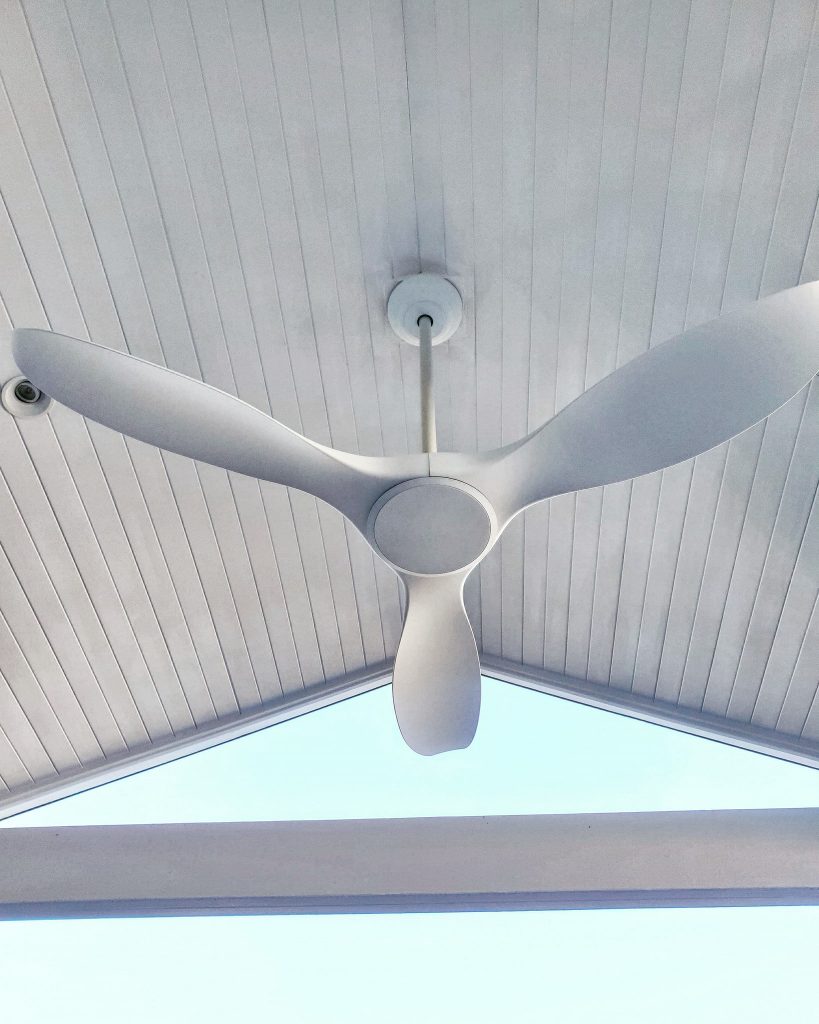
A raked ceiling won’t take a standard fan mount — the blades would sit at an unsafe angle and risk striking the ceiling. This needs a downrod to drop the fan clear of the slope, plus an angled mounting kit with a pivoting joint so the fan hangs vertically regardless of the ceiling’s pitch. Many Hills District homes have vaulted living areas, and this is assessed and priced on the day rather than quoted sight-unseen, since the pitch and joist access vary property to property.
Scenario 3: Converting a Light Point to a Fan Point
Replacing a downlight or pendant with a ceiling fan isn’t a straight swap, even though it looks like one from the room. A light fitting is a static load and is often supported on a light-rated hook or a standard ceiling anchor — neither is rated to carry a spinning fan long-term. The existing point has to be assessed for whether it can take a fan-rated bracket, and upgraded to timber blocking if it can’t, before the fan goes up. This is exactly the assessment we carried out on a granny flat conversion in Dural that later led to six more fans throughout the main house.
If the fan going in is an AC model with an integrated light kit and wall-switch control, this scenario adds one more variable: two separate switch wires are needed — one for the fan, one for the light — rather than the single wire a light fitting needed. DC and remote-controlled fans don’t have this extra cost, since the receiver handles both fan and light from the one wire. Multi-fan jobs add another variable again — see our real cost breakdown from a Gables alfresco job, where adding a third fan meant relocating two existing wiring points for even spacing.
What Applies No Matter Which Scenario You’re In
These three requirements are fixed by fan manufacturers and NSW licensing — they don’t change based on ceiling type or motor type. See our full Ceiling Fan Installation Requirements page for the complete breakdown of what’s a legal requirement versus a manufacturer requirement:
- An isolating switch per fan. Every manufacturer’s installation instructions require one, dedicated to that fan.
- Minimum 2.1m floor-to-blade clearance. A fixed manufacturer requirement, not a suggestion.
- Minimum 300mm blade-to-wall clearance. Worth checking before committing to a fan in a tight corner or near a sloped section of ceiling.
- Licensed installation, regardless of motor type. Ceiling fan installation in NSW — plasterboard, raked, DC, or AC — is prescribed electrical work. It must be carried out by a licensed electrician and issued with a Certificate of Compliance.
DC vs AC — the Part That Matters Less Than People Assume
Roughly 9 in 10 fans we install or replace across the Hills District and Hawkesbury are now DC motor units, mainly because DC runs quieter — the deciding factor for a bedroom. DC also avoids the extra switch-wire cost that applies to wall-switch controlled AC fans with a light kit, since the remote receiver handles fan and light from a single wire. But motor type doesn’t change the ceiling-type requirements above, and it’s rarely the biggest line item in the quote. See our full DC vs AC ceiling fan comparison if you want the detail.
Real Pricing — Hills District & Hawkesbury
| Job | Price |
|---|---|
| Ceiling fan replacement (existing wiring and bracket) | From $160 + GST per fan |
| New ceiling fan installation (new circuit required) | From $280 + GST per fan |
| Extra switch wire (AC fan with light kit, wall-switch control) | +$90 + GST per fan |
| Timber blocking (where required) | $80 + GST per fan |
| Raked/vaulted ceiling installation | Assessed on site |
All prices exclude GST. Fixed price before any work begins — no call-out fee, no hourly rate. The extra switch wire charge applies only to AC fans with a light kit on wall-switch control — DC fans and remote-controlled units of either motor type need only one switch wire regardless of the light kit.
Saunders Electrical Group installs and re-secures ceiling fans across the Hills District and Hawkesbury, on every ceiling type. Every job includes a Certificate of Compliance and our lifetime workmanship guarantee. Call 1300 993 560 for a fixed-price quote.
Related: Ceiling Fan Installation — Hills District & Hawkesbury · Ceiling Fan Installation Requirements · Ceiling Fan Installation FAQ · DC vs AC Ceiling Fans: What Actually Matters · What a 3-Fan Alfresco Install Actually Costs — The Gables · Why Your Ceiling Fan Wobbles · One Fan Became Seven: A Dural Whole-Home Upgrade
Frequently Asked Questions
Why do some ceiling fan quotes cost more than others for the same fan?
The fan itself is rarely what changes the price. What changes it is the ceiling: whether the mounting point already has a joist behind it, whether timber blocking needs to be added, whether it’s a raked ceiling needing a downrod and angled mount, or whether an existing light point needs upgrading to take a fan-rated bracket.
Can a ceiling fan be mounted on plasterboard alone?
No. Plasterboard can’t take the ongoing vibration of a spinning fan. The bracket needs to be fixed to a timber joist or a timber block fitted between joists.
Do I need a different installation approach for a raked ceiling?
Yes. A raked or vaulted ceiling needs a downrod and an angled mounting kit so the fan hangs vertically despite the ceiling’s pitch. This is priced on assessment since pitch and joist access vary by property.
Can I convert an existing light fitting into a ceiling fan?
Yes, but the point needs to be assessed first. A light fitting is typically supported on hardware rated for a static load, not a spinning fan — if it’s not fan-rated, it needs to be upgraded before the fan goes up.
Do all ceiling fans need their own isolating switch?
Yes. Manufacturer installation instructions require a dedicated isolating switch per fan, regardless of motor type or ceiling type.
Do I need a licensed electrician to install a ceiling fan in NSW?
Yes. Ceiling fan installation is prescribed electrical work in NSW, and must be carried out by a licensed electrician with a Certificate of Compliance issued on completion.
Why does an AC fan with a light kit sometimes cost more than a DC fan with a light kit?
A wall-switch controlled AC fan with an integrated light kit needs two separate switch wires — one for the fan, one for the light — adding $90 + GST to the job. DC fans and remote-controlled fans of either motor type only need one switch wire, since the remote receiver handles both functions.