
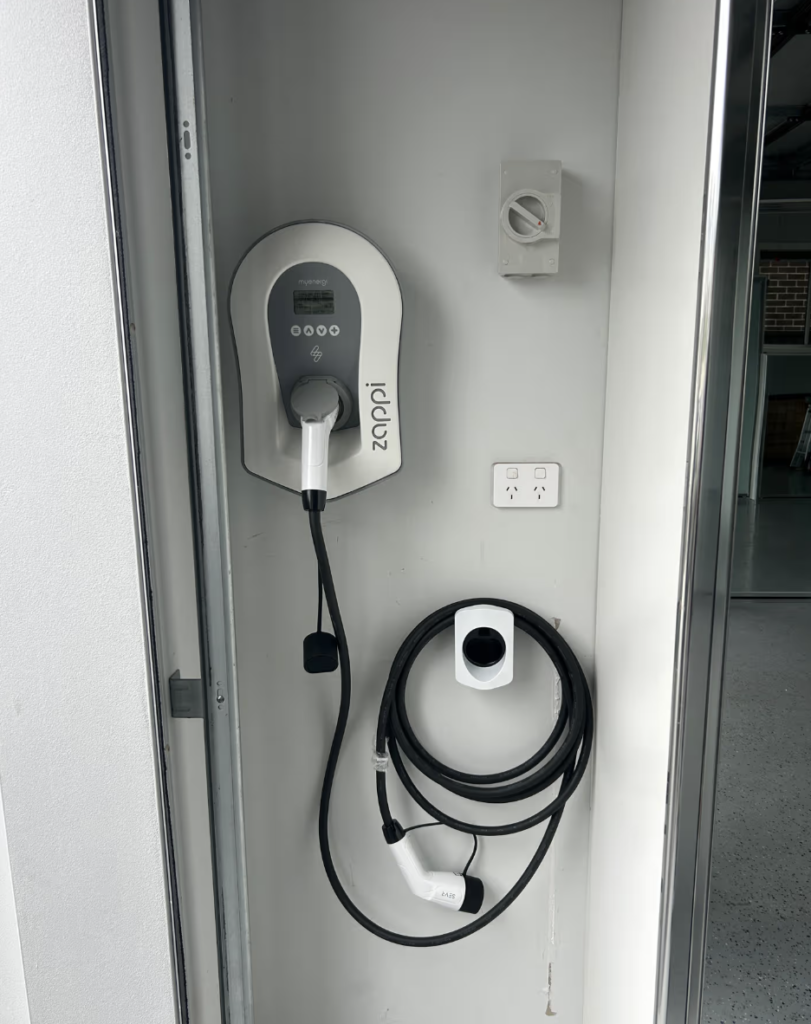
A 3-phase zappi does not have to be installed at its full 22kW (32A per phase). If the car can only accept 11kW, configuring the charger to 16A per phase lets a licensed electrician size the cable to the real load, which is exactly what Saunders Electrical Group (Licence 344815C) did on a Box Hill installation on 28 September 2026. The job cost $2,350 + GST with a customer-supplied untethered zappi, and matching the charger to the car saved the homeowner $190 in cable and labour.
This post walks through the actual decisions on that job: the cable calculation, the current limit, the grid limit, and how the zappi was set up to work with the home’s solar and battery. If you have 3-phase power in the Hills District and are weighing up a zappi, the numbers below are the ones that matter.
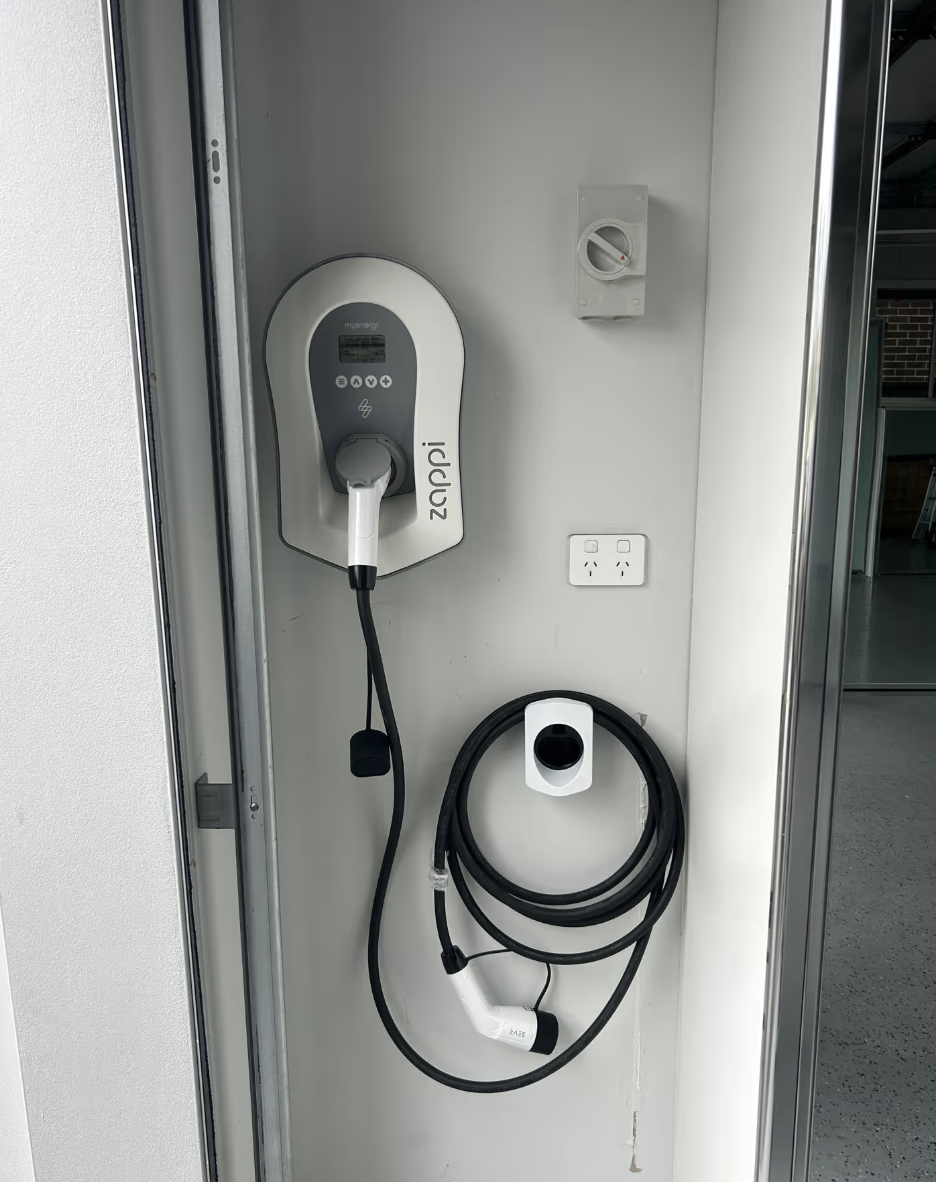
The job in one table
| Suburb | Box Hill, NSW 2765 |
| Charger | myenergi zappi, 3-phase, untethered (customer supplied) |
| Vehicle onboard AC charger | 11kW |
| Charger current limit set | 16A per phase (11kW) |
| Supply cable | 6mm² after voltage drop and derating calculations |
| Main switch | 63A |
| zappi grid limit set | 59A |
| Solar and battery integration | Yes, configured on the day |
| Installation cost | $2,350 + GST |
| Saving from matching charger to car | $190 |
Why the car’s onboard charger decides the cable, not the zappi
Every EV has an onboard AC charger with a fixed ceiling. Many popular models in Australia cap AC charging at 11kW, and some at 7kW. A 3-phase zappi is capable of 22kW, but the car will never draw more than its own onboard charger allows. On this Box Hill job the vehicle was rated to 11kW, which on a 3-phase supply is 16A per phase.
Cable is selected under AS/NZS 3000:2018 and AS/NZS 3008.1.1 based on the current the circuit will actually carry, the installation method, the run length and the derating factors that apply to how the cable is enclosed and grouped. Voltage drop across the installation must also stay within the 5% limit set by the Wiring Rules. myenergi’s own zappi cable sizing guidance lists 6mm² as the minimum for a full 32A feed and notes that the actual size depends on installation method and run length. At 32A per phase, a 3-phase EV circuit in a Hills District home often pushes past what 6mm² cable can carry once Australian derating factors are applied, particularly on longer runs through roof spaces. At 16A per phase, the same 6mm² cable sits comfortably inside its rating with margin to spare.
So we ran the calculation both ways for this specific route. The result: 6mm² was compliant and appropriate for a 16A per phase circuit, and the zappi was configured with a 16A maximum current limit so the circuit can never be asked to carry more than the cable was sized for. That decision is what saved the homeowner $190.
“The client had done his homework and wanted an installer who understood the zappi well enough to configure it properly, rather than defaulting to the biggest cable and the highest current,” says Oliver Saunders, owner of Saunders Electrical Group. “The car can only take 11kW. Installing for 22kW would have cost him more for charging speed he can’t use.”
The grid limit: 59A on a 63A main switch
The second setting most people never hear about is the zappi’s grid limit. This tells the charger the maximum total current the house is allowed to import from the grid. When the oven, air conditioning, hot water or other loads are running, the zappi measures total household draw through its CT clamps and throttles its own charging current down so the combined load stays under the limit. This is the dynamic load balancing myenergi is known for, and it is what stops an EV charger from tripping the main switch on a busy evening. myenergi documents the feature in its zappi supply input grid limit declaration.
On this home the main switch is 63A. We set the grid limit to 59A, four amps below the main switch rating, so the zappi backs off well before the switch is under stress. The number is not a default; it is set per switchboard, and if it is left at the factory setting or set above the main switch rating the feature does nothing useful.
Does limiting the zappi to 11kW slow charging?
Not for this car. The vehicle’s onboard charger is the bottleneck at 11kW regardless of what the zappi could deliver. An 11kW AC charge adds roughly 60 to 70km of range per hour for a typical mid-size EV, which is more than enough for overnight charging in Box Hill. If the homeowner later buys a car with a 22kW onboard charger, the current limit can be raised, but the cable would need to be reassessed for the higher load. We told the client this on the day so the decision was made with eyes open.
Solar and battery integration
The zappi was configured to work with the home’s existing solar system and battery. In ECO and ECO+ modes the charger prioritises surplus solar generation, so the car charges from the roof before drawing from the grid, and the CT configuration was checked so the zappi reads solar export and battery charge and discharge correctly. For a breakdown of how the three charging modes work, see our myenergi zappi charging modes guide.
Safety and compliance
The zappi includes integral 30mA Type A RCD protection with 6mA DC leakage detection, which satisfies the EV charging requirements in Appendix P of AS/NZS 3000:2018 without an external Type B RCD. The circuit was installed, tested and documented by a licensed electrician under Contractor Licence 344815C, and the customer received a Certificate of Compliance for Electrical Work. Our switchboard and supply requirements for EV chargers are covered in detail on the EV charger installation requirements page.
What the customer said
The homeowner left a five-star Google review the same afternoon, describing the job as “quality workmanship, with no shortcuts” and noting that the team “arrived on time and finished the job without rushing.” The full review is on our Google Business Profile.
Considering a 3-phase zappi in the Hills District?
Saunders Electrical Group is a local electrician in Box Hill and installs and configures myenergi zappi chargers across Box Hill, Rouse Hill, Kellyville, Castle Hill, Kenthurst and the wider Hills and Hawkesbury region. Before quoting, we ask what car you drive, because the answer changes the cable, the configuration and the price. Visit our EV charger installation page to book an assessment, or read our earlier zappi GLO installation in Box Hill for a solar-only example.
Frequently asked questions
Can a 3-phase zappi be installed on 6mm cable?
Yes, when the charger’s current limit is set to match the load the cable is sized for. On a Box Hill job in September 2026, Saunders Electrical Group installed a 3-phase zappi on 6mm² cable after configuring the charger to a 16A per phase (11kW) maximum, with voltage drop and derating calculated for the specific route under AS/NZS 3000:2018.
What does setting a zappi to 16A per phase do?
It caps the charger at 11kW on a 3-phase supply. If the car’s onboard AC charger is rated to 11kW, this limit costs no charging speed and allows the supply cable to be sized to the real load rather than the charger’s 22kW maximum.
What should the zappi grid limit be set to?
Below the rating of the home’s main switch. On a 63A main switch, Saunders Electrical Group set the zappi grid limit to 59A so the charger throttles down automatically when other household loads are running, preventing the main switch from tripping.
How much does a 3-phase zappi installation cost in the Hills District?
A 3-phase zappi installation in Box Hill by Saunders Electrical Group cost $2,350 + GST in September 2026 with a customer-supplied charger, including 6mm² cabling, 16A per phase configuration, grid limit setup and solar and battery integration. Price varies with cable route length and switchboard condition.
Does limiting a 22kW zappi to 11kW slow down charging?
Not if the car’s onboard AC charger is rated to 11kW or less, because the car is the bottleneck. Most EVs sold in Australia accept 11kW or less on AC, so a 22kW configuration provides no benefit for those vehicles.
Does the zappi still work with solar and a battery when current-limited?
Yes. The current limit sets the maximum the zappi can draw; ECO and ECO+ modes still prioritise surplus solar and respect battery charging and discharging as read through the CT clamps.
Do you install EV chargers in Box Hill?
Yes. Saunders Electrical Group is a licensed electrician serving Box Hill and the surrounding Hills District, installing single-phase and 3-phase EV chargers including the myenergi zappi, with configuration for solar and home batteries.