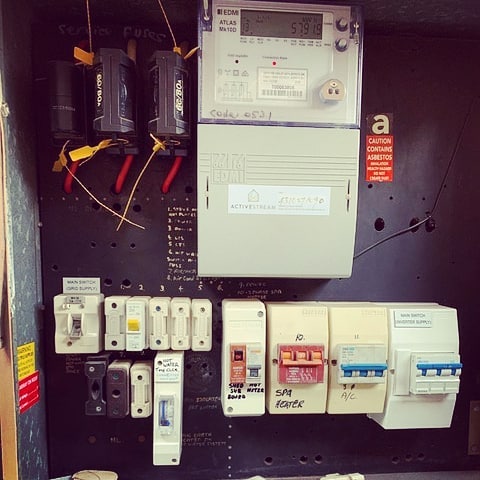
The switchboard, not the charger, is what decides whether your EV charger installation is a straightforward job or a bigger one. Under AS/NZS 3000:2018 (Appendix P), every EV charging circuit has to be assessed against the property’s maximum demand — the total load the switchboard is already carrying — before a charger is ever selected. In Saunders Electrical Group’s own installation data across the Hills District, roughly one in ten EV charger jobs turn into a switchboard upgrade first, because the existing board simply can’t take the extra draw.
Most guidance on EV charger installation treats it as a product decision: pick a charger, book an electrician, get it mounted. That’s true for the minority of homes with modern, high-capacity switchboards and spare circuit space. For a meaningful share of Hills District homes — particularly older double-storey properties in areas like Kellyville, Castle Hill and Dural that haven’t had a switchboard upgrade since original construction — the charger is the easy part. The board is the actual constraint.
Why the Switchboard Comes First
AS/NZS 3000 Appendix P2 requires that every EV connecting point be assessed as though it will draw its full rated current continuously, and if there’s more than one connecting point, the standard requires the installation to be assessed as if all of them could be used simultaneously. That’s a materially higher load assumption than most other appliances get, which is why a switchboard that comfortably runs a home’s lighting, cooking and air-conditioning can still fail an EV maximum demand check.
“About one in ten EV jobs we run in the Hills District aren’t really EV jobs — they’re switchboard jobs. The charger install itself takes a couple of hours. Finding out the board can’t handle it takes longer, and it’s better we find that before the customer’s ordered the car charger than after,” says Oliver Saunders, founder of Saunders Electrical Group.
What SEG Actually Installs in the Hills District
Charger sizing depends on supply type and how fast the homeowner wants to charge:
- 7kW single-phase, 32A circuit — the most common residential install, suited to overnight charging on a standard single-phase supply.
- 11kW single-phase — for homes with higher single-phase supply capacity wanting faster charge times without a three-phase upgrade.
- 22kW three-phase, 32A or 40A circuit — for homes with three-phase power already installed, or where the homeowner wants the fastest practical home charge speed.
SEG installs all three configurations regularly across the Hills District, including a high volume of both single-storey and double-storey homes in Kellyville, where three-phase 22kW installs are increasingly common in newer builds and 7kW/11kW single-phase remains standard in older double-storey stock. Worth knowing before you spec a charger: some EVs simply can’t use anything above 7–11kW regardless of what your switchboard can supply. Both the BYD Sealion 6 and Sealion 7 cap their onboard AC charging at 7kW on single-phase power (11kW on three-phase for the Sealion 7 only) — see why your BYD Sealion charges slowly, and what actually fixes it for the full breakdown. Demand for exactly this kind of install has accelerated fast — see why Australia’s EV tipping point means more homes need a compliant switchboard assessment before a charger goes in.
The Compliance Requirements Under AS/NZS 3000
Beyond switchboard capacity, Appendix P sets specific installation requirements that apply to every home EV charging circuit:
- Dedicated circuit — each connecting point must be supplied by its own final subcircuit, not shared with any other socket-outlet or point (Appendix P3.1, P4.2).
- RCD protection — every connecting point needs its own RCD of at least Type A with a rated residual current not exceeding 30 mA, and where the charger uses a connector under the IEC 62196 series, additional d.c. fault current protection is required — either RCD Type B, or Type A paired with equipment that disconnects on d.c. fault current above 6 mA (Appendix P4.1).
- Weatherproofing for outdoor installs — chargers mounted outdoors need a minimum IPX4 rating against water splash and IP4X against solid object ingress (Appendix P3.2.1, P3.2.2).
- Mechanical protection — chargers in driveways, carports or anywhere a vehicle manoeuvres need protection against impact damage, and cables can’t be positioned where they could be run over or pinched (Appendix P3.2.3, P6).
None of this is optional or a “nice to have” — it’s what a licensed electrician is checking against when they assess a property, and it’s why a proper EV charger quote in the Hills District should always start with a switchboard and circuit assessment, not a charger brand conversation.
What This Means Before You Book
If your home hasn’t had a switchboard upgrade in the last 10–15 years, or you’re in an older double-storey property in the Hills District, it’s worth getting the switchboard assessed against EV maximum demand requirements before locking in a charger purchase. It changes the scope, the timeline and the cost — and it’s far better to know that upfront than after the charger has arrived.
SEG holds NSW Electrical Contractor Licence 344815C and installs 7kW, 11kW and 22kW home EV charging systems across the Hills District and Hawkesbury region, with every install assessed against AS/NZS 3000 Appendix P from the first site visit. For a full breakdown of the installation process, see our EV Charger Installation Guide, or check how long an EV charger installation actually takes. For a real example of what happens when these requirements aren’t followed, see why the cheapest EV charger quote isn’t always right. For common buyer questions before you install, see our EV Charger Installation FAQ Hills District. If you’re a BYD owner specifically, see why your BYD Sealion is charging slowly and what it’s really worth switching to EV. For local service details, visit our EV Charger Installation Hills District page. And for the bigger picture on why this all matters right now, read Australia’s EV Tipping Point Just Arrived — Is Your Home Wiring Ready?
Frequently Asked Questions
Does every home need a switchboard upgrade before installing an EV charger?
No. Most Hills District homes with a switchboard installed or upgraded in the last 10–15 years can take an EV charger circuit without any board changes. Based on SEG’s own installation data, roughly one in ten Hills District EV charger jobs require a switchboard upgrade first, usually in older properties where the existing board is already close to capacity.
What size EV charger circuit do I need?
It depends on your supply and charging speed needs. A 7kW charger runs on a single-phase 32A circuit and suits most overnight home charging. An 11kW charger needs higher single-phase capacity. A 22kW charger requires three-phase power on a 32A or 40A circuit and gives the fastest practical home charge speed.
Does an EV charger need its own dedicated circuit?
Yes. Under AS/NZS 3000 Appendix P, every EV charging connecting point must be supplied by its own dedicated final subcircuit — it cannot share a circuit with any other socket-outlet or electrical point in the home.
What RCD protection is required for a home EV charger?
Every EV charging connecting point needs its own RCD rated at least Type A with a maximum residual current of 30 mA. Where the charger uses certain connector types, additional protection against d.c. fault current is also required — either an RCD Type B, or a Type A RCD combined with equipment that disconnects on d.c. fault current above 6 mA.
Can an EV charger be installed outdoors?
Yes, provided it meets minimum weatherproofing and mechanical protection standards — at least IPX4 rated against water splash, IP4X against solid object ingress, and positioned or protected so it can’t be damaged by a vehicle or have its cable run over.