
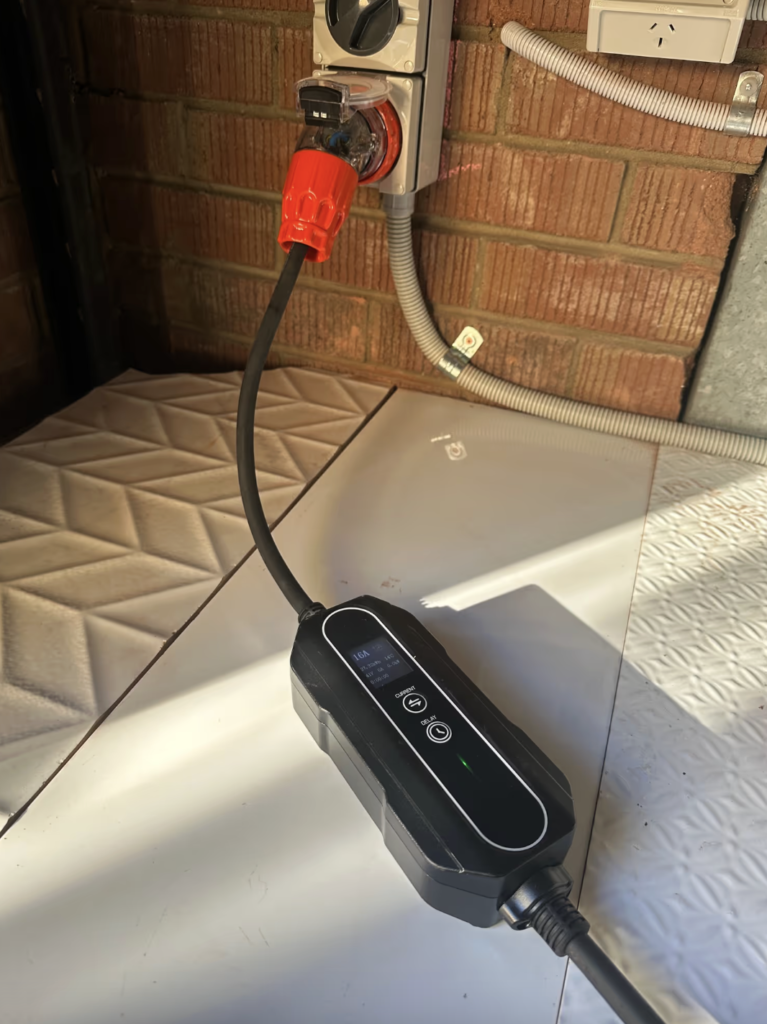
A German testing body just put hard numbers on something Hills District EV owners have been guessing at for years: charging straight off a household power point doesn’t just take longer — it wastes real electricity, and the waste is bigger than most people assume. ADAC, Germany’s largest motoring club, tested five EV models across three home-charging setups and found standard power point charging lost between 12.7% and 24.2% of the electricity drawn from the wall. A proper wall box charger cut that loss roughly in half. As a licensed electrical contractor installing EV chargers across Kenthurst, Castle Hill, Baulkham Hills and the wider Hawkesbury, we think this is the number Hills District EV owners have been missing.
What ADAC Actually Tested
ADAC charged five EV models — the Tesla Model Y, Mercedes CLA 350 EQ, Volkswagen ID.7, Renault R5 E-Tech and Volvo EX30 — from 10% to 90% battery, using three charging methods:
- A standard household power point (2.3kW)
- An 11kW wall box charger
- A 4.1kW wall box set to mimic solar-matched charging
Germany’s residential supply runs at 230V single-phase and 400V three-phase — identical to the standard supply in NSW homes — so the results translate directly to an Australian garage.
The Results: How Much Power Actually Gets Wasted
| Vehicle | Power point (2.3kW) waste | 11kW wall box waste | 4.1kW solar-matched waste |
|---|---|---|---|
| Mercedes CLA 350 EQ | 24.2% | 6.9% | 12.8% |
| Volkswagen ID.7 | 15.3% | 6.9% | 10.6% |
| Volvo EX30 | 14.2% | 7.0% | 9.1% |
| Renault R5 E-Tech | 13.7% | 5.1% | 8.0% |
| Tesla Model Y | 12.7% | 6.1% | 9.4% |
ADAC put the Mercedes’ unusually high power point loss down to its onboard charger drawing current at just eight amps — a reminder that the car’s own onboard charger, not just the outlet, plays a part in how much is lost as heat rather than stored as range.
What This Actually Costs a Hills District EV Owner
The average Australian drives around 33km a day. For a mid-size EV using roughly 180Wh per kilometre, that’s about 6kWh of usable charge needed daily — just under 2,200kWh a year.
Run that through the waste rates above at a typical NSW residential electricity rate of around $0.30/kWh, and the gap between power point charging and wall box charging works out to roughly $50–$130 a year in electricity you’re paying for but never actually gets into the battery — before you factor in that a power point charge on a mid-size EV takes 30+ hours from empty, against an overnight charge on a wall box.
It’s not a figure that will change anyone’s week. But it’s the kind of quiet, ongoing cost that most EV owners have never had put in front of them — because most advice on EV charging talks about speed, not waste.
Why This Matters More With NSW’s Time-of-Use Tariffs
The waste percentages above apply regardless of what you’re paying per kWh — but NSW’s shift toward time-of-use electricity tariffs means the actual dollar cost of that waste depends heavily on when you charge. A power point charge that spans peak, shoulder and off-peak windows because it takes 30+ hours wastes electricity at whatever the blended rate ends up being. A wall box charge that completes overnight can be scheduled to sit entirely inside the cheapest off-peak window — compounding the efficiency saving with a rate saving on top of it.
What This Means If You’re Charging Off a Power Point Right Now
Under AS/NZS 3000, a dedicated EV charging circuit needs its own breaker sized correctly for continuous load — a standard power point on a shared household circuit isn’t designed to run at near-maximum draw for 30+ hours at a time, night after night. Beyond the wasted power, that’s the bigger risk we see on switchboards across Kenthurst, Castle Hill and Rouse Hill: general power circuits carrying a load they were never speced for.
If you’re currently charging off a power point and considering a wall box, the two things worth checking first are whether your switchboard has capacity for a dedicated circuit, and whether your home is single-phase or three-phase — because that determines whether an 11kW or 22kW wall box is even an option for your property. See our full EV charger installation guide for the Hills District for pricing, brands, and what’s involved.
Frequently Asked Questions
How much electricity does charging an EV from a power point actually waste?
Independent German testing by ADAC found household power point charging (2.3kW) wasted between 12.7% and 24.2% of the electricity drawn, depending on the vehicle’s onboard charger. A dedicated wall box charger cut that waste to between 5.1% and 7.0% across the same models.
Is it worth installing an EV wall box charger just to reduce power waste?
Waste reduction alone can save a typical Hills District EV owner somewhere in the order of $50–$130 a year in electricity that’s paid for but never reaches the battery — on top of dramatically shorter charge times and better safety margins on the circuit. For most households the case for a wall box installation rests on all three factors together, not waste alone.
Does Australia’s power supply match the conditions in the German EV charging study?
Yes. Australian residential electricity supply runs at 230V single-phase and 400V three-phase — the same standard used in the German testing — so the wastage results apply directly to Australian homes, including NSW.
What’s required to install an EV charger under Australian wiring rules?
AS/NZS 3000 requires EV charging equipment to run on its own dedicated circuit with a correctly sized breaker, installed by a licensed electrician. A standard power point isn’t designed for the sustained, near-continuous load an EV draws over a 30+ hour charge.