
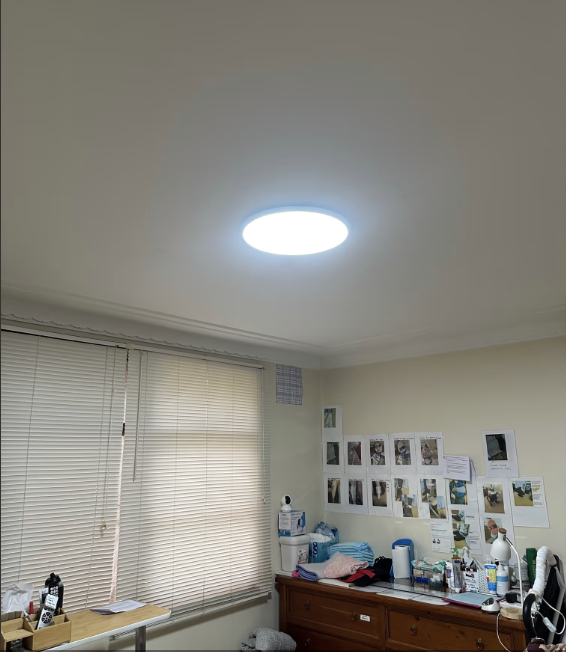
The Job: Pendant-to-Oyster Upgrade, Annangrove
If you’re replacing old pendant lights in a home built before the 1990s, don’t assume the light points are earthed — many aren’t, and it changes which replacement fittings you can legally install without opening the ceiling. Saunders Electrical Group replaced two ageing pendant lights with LED oyster lights in an older Annangrove home this week, and the job is a useful example of a compliance issue that shows up constantly in Hills District homes of this era but rarely gets explained to homeowners.
Once the old pendant fittings were removed, neither light point had an earthing conductor run to it — no earth cable, just active and neutral. This wasn’t a fault or an oversight from a previous job. It reflects how a lot of ceiling lighting points were originally wired: if the fitting being installed didn’t require an earth connection, an earth conductor often wasn’t run to that point at all.
Why This Matters When You Upgrade a Light Fitting
Under AS/NZS 3000, any fitting with exposed conductive metal parts needs to be connected to earth, protected by a residual current device, or built as a double-insulated (Class II) fitting that doesn’t rely on an earth connection at all. A plain pendant fitting from decades ago may have been compliant without an earth wire because it wasn’t Class I equipment requiring one. Swap it for a metal-bodied LED fitting that does need earthing, and the missing earth conductor becomes a real problem — not a technicality.
The standard fix is to run a new earth cable back to the switchboard. In a lot of homes that means cutting access holes through the ceiling to reach the cavity above the light point, patching and repainting afterward — extra cost and extra disruption for what looks like a simple light swap.
The Solution: Double-Insulated LED Oyster Lights
For this Annangrove job, we installed double-insulated (Class II) LED oyster lights instead. Class II fittings are manufactured with two layers of insulation, or reinforced insulation, between any live part and the outer casing — the fitting is designed so there’s no exposed conductive part that could become live in a fault condition, which is exactly what an earth connection exists to protect against on a Class I fitting. Because there’s no exposed conductive part to earth, the fitting doesn’t need one.
That meant no earth cable to run, no ceiling access holes, and no patch-and-paint bill. The client got a fully compliant, brighter, more efficient LED oyster light in place of the old pendant, in a single visit.
What to Ask Before You Upgrade Old Light Fittings
If your home was built before the 1990s and you’re planning to replace old pendant or batten holder lights, ask your electrician to check whether the light points are earthed before you commit to a fitting. If they’re not, and the replacement fitting you want is Class I (metal-bodied, needs earthing), you’re looking at either a ceiling access job to run new earth cable, or a double-insulated fitting that avoids the issue entirely. Knowing this before the quote — not after the old fitting is already off the ceiling — is what keeps the job on budget.
Frequently Asked Questions
Why didn’t my old light fitting have an earth wire?
In many homes built before the 1990s, light points were wired with only active and neutral conductors, no earth. This was compliant at the time because the fittings installed didn’t have exposed conductive parts requiring an earth connection.
Do LED oyster lights need to be earthed?
It depends on the fitting. Double-insulated (Class II) LED oyster lights don’t require an earth connection, because they’re built with two layers of insulation so there’s no exposed conductive part that could become live. Metal-bodied Class I fittings do require an earth connection.
What happens if a light point has no earth wire and I want a fitting that needs one?
An earth conductor needs to be run from the switchboard to the light point, which can require cutting access holes in the ceiling in homes with limited cavity access. A double-insulated fitting avoids this by not requiring an earth connection at all.
Is Saunders Electrical Group licensed for lighting upgrades in Annangrove?
Yes. Saunders Electrical Group holds NSW Electrical Contractor Licence 344815C and services Annangrove, Kenthurst, Castle Hill, Dural and the surrounding Hills and Hawkesbury suburbs.