
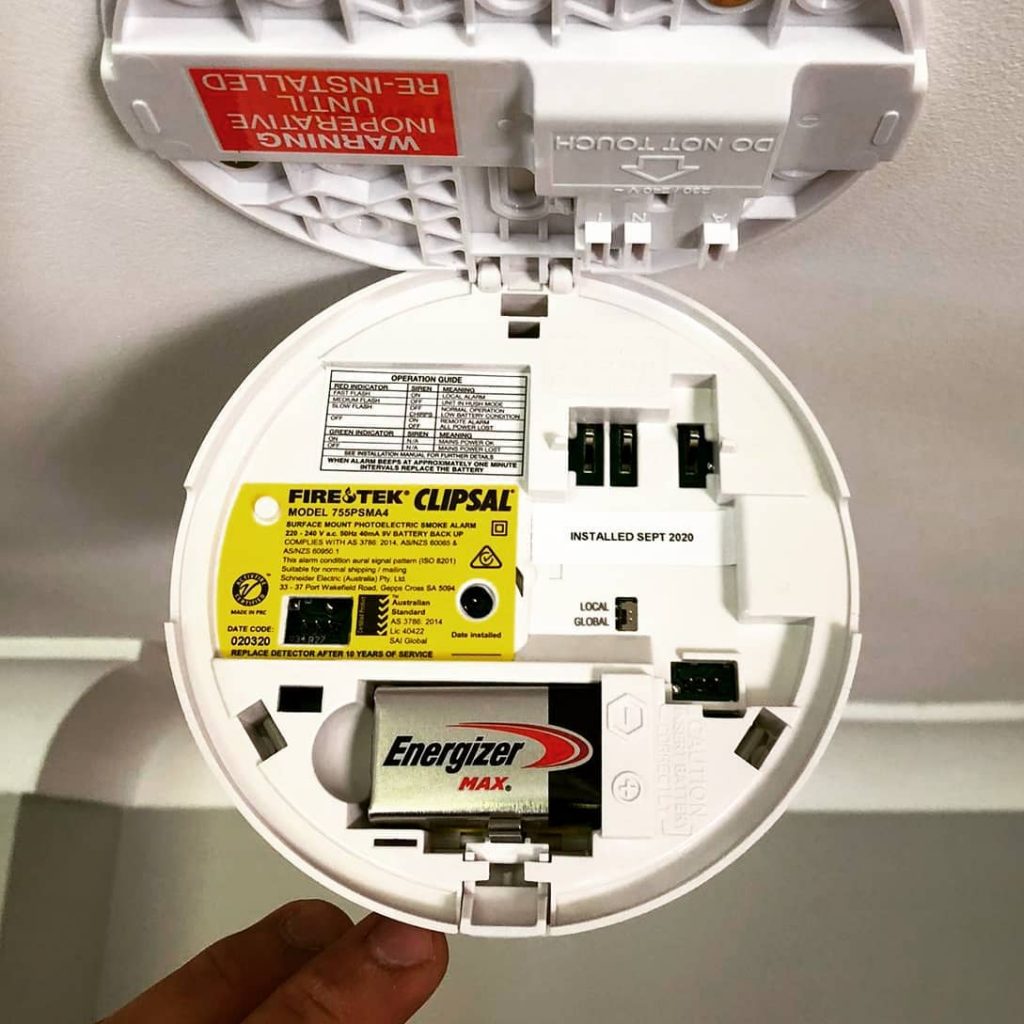
If your smoke alarm is chirping, the fault probably isn’t the battery — it’s the alarm’s age. Under Australian Standard AS 3786, every smoke alarm in NSW must be replaced within 10 years of its manufacture date, and most homeowners don’t realise that date is stamped on the unit itself until they go looking for it.
We saw this again this week on a job in Kellyville Ridge. The homeowner’s smoke alarm had started chirping intermittently, and they went to swap the 9V battery — standard first move. But while the alarm was off the ceiling plate, they noticed a manufacture date stamped on the back: almost 20 years old. Instead of putting a fresh battery in an alarm that was already twice past its legal service life, they called us.
Why a chirping alarm usually isn’t a battery problem
A smoke alarm’s sensing chamber degrades with age — dust, insects, humidity and general wear all reduce its ability to detect smoke accurately over time. Manufacturers and the Australian Standard both set the cut-off at 10 years from the date of manufacture, not from the date it went on your ceiling. An alarm installed five years ago could already be 15 years old if it came out of a trade supply cupboard, a builder’s leftover stock, or was moved from a previous property.
That distinction matters because a low-battery chirp and an end-of-life chirp sound identical to most people. The difference is on the unit itself — every compliant smoke alarm has either a manufacture date or an expiry date printed on the back or base, usually near the battery compartment.
What we replaced in Kellyville Ridge
Three smoke alarms, all close to 20 years old, all overdue by roughly a decade. We installed three hardwired smoke alarms with 9V battery backup — mains-powered off the lighting circuit so the alarm keeps working during a power outage, with the battery as a secondary fail-safe rather than the primary power source. This is the standard hardwired configuration for NSW residential properties and it’s what AS 3786 compliant hardwired units are built around.
Since 1 May 2006, under Division 7A of Part 9 of the Environmental Planning and Assessment Regulation 2000, every NSW dwelling where people sleep must have working smoke alarms meeting AS 3786 installed on each level. Replacement alarms have to meet the current 2014 edition of the standard, and if the alarm being replaced was hardwired, the replacement must be hardwired too — you can’t downgrade to a battery-only unit at replacement time.
How to check your own alarms before you get a chirp
Take the alarm down from its mounting plate and look at the base or back, near the battery compartment. You’re looking for either a printed manufacture date or an expiry date. If you can’t find one, or if it’s more than 10 years old, it’s due for replacement regardless of whether it’s still chirping, silent, or passes a test-button check — a working test button confirms the electronics respond, not that the smoke sensor is still accurate.
If you’ve got hardwired alarms, this isn’t a DIY swap — hardwired smoke alarm replacement in NSW has to be done by a licensed electrician, since it involves working on a live circuit connected to your switchboard.
Frequently asked questions
How do I know how old my smoke alarm actually is?
Remove the alarm from its ceiling mounting plate and check the base or back near the battery compartment for a printed manufacture date or batch code. If there’s no visible date and you don’t know when it was installed, treat it as overdue and have it checked.
Can I replace a hardwired smoke alarm myself?
No. A hardwired smoke alarm is connected to your home’s mains wiring, and replacing it is electrical work that legally requires a licensed electrician in NSW.
Does a working test button mean my smoke alarm is fine?
Not necessarily. The test button confirms the alarm’s electronics and speaker are functioning — it doesn’t confirm the smoke-sensing chamber is still detecting smoke accurately, which is what degrades with age.
Do I have to replace a hardwired smoke alarm with another hardwired one?
Yes. Under NSW requirements, if the smoke alarm being replaced was hardwired, its replacement must also be hardwired — you can’t substitute a battery-only unit.