
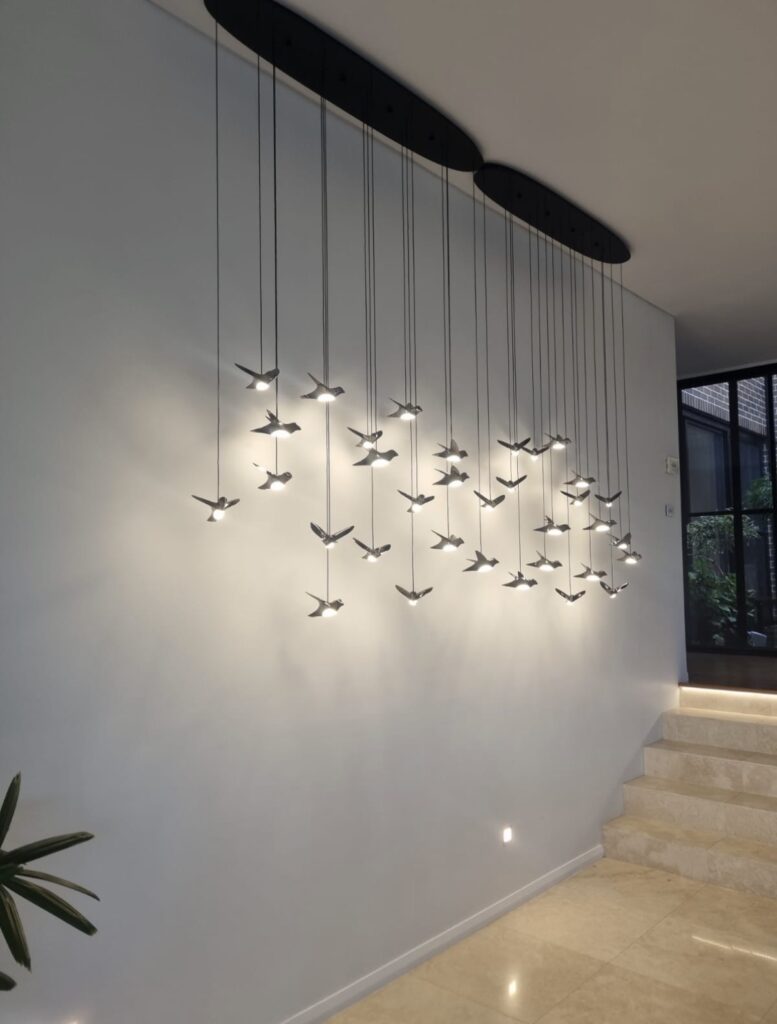
Installing a statement pendant light isn’t an electrical challenge — it’s a precision challenge. Saunders Electrical Group, a licensed residential electrical contractor serving Sydney’s Hills District and Hawkesbury region, recently installed a multi-drop feature pendant in a North Kellyville home, and the job confirmed something most electricians won’t tell you: the wiring takes an hour, but getting the fixture to look right can take most of the day.
The Job: Two Eglo Paratebueno Pendants, One Entry Hallway
The brief was to install two Eglo Paratebueno pendants side by side along a feature wall in a North Kellyville entry hallway — each fixture made up of dozens of individual bird-shaped drops suspended at varying cable lengths, designed to read as a flock caught mid-flight. The job required wiring both fixtures to a new switch and took an electrician and an apprentice approximately 6 hours from start to finish, including height adjustments to the customer’s exact satisfaction.
Electrically, this is a straightforward job: two supply points, standard low-voltage connections, mounting to a solid ceiling fixing point. That part was done inside the first hour.
The rest of the day went into something no spec sheet prepares you for: adjusting each individual drop to the exact height needed to build the pattern the client wanted. With dozens of suspension points across two fixtures mounted side by side, even small inconsistencies in drop height are immediately obvious against a plain feature wall — there’s nowhere for an uneven line to hide.
Why This Is a Patience Problem, Not a Wiring Problem
Most pendant lighting content online treats installation as one task: mount it, wire it, test it. That’s accurate for a single pendant over a kitchen island. It’s not accurate for a multi-drop feature installation, where the visual outcome depends entirely on relative height across every single drop point.
The process on a job like this is: measure, adjust, step back, check the sightline from the angles the client will actually see it from, then repeat — often a dozen times per fixture before the pattern reads correctly. Rush this step and you get a fixture that looks like separate lights hung at random heights, rather than one deliberate feature.
“With this many suspension points, the electrical work is the easy part,” said Oliver Saunders, founder of Saunders Electrical Group and licensed electrical contractor (Licence 344815C). “The job is really won or lost on whether you’re prepared to keep adjusting until the pattern is right, instead of calling it close enough.”
What the Standard Actually Requires
AS/NZS 3000:2018 sets requirements for equipment wiring on installations like this — Clause 4.3.6 specifies that flexible cord or cable to a luminaire should be as short as practicable, with a maximum recommended length of 2.5 metres, and must be protected against damage or deterioration from heat generated by the luminaire itself. On a multi-drop fixture with dozens of individual cables at different lengths, that’s a real constraint electricians have to work within while still hitting the visual outcome the client wants — not just a box to tick after the fact.
The Result
Two fixtures, installed side by side, reading as one continuous feature rather than two separate lights — which was the whole point of specifying two Paratebueno pendants instead of one larger fixture in the first place.
Frequently Asked Questions
How long does it take to install a statement pendant light?
A single pendant over a kitchen island or dining table is usually a straightforward job of an hour or two. A multi-drop feature installation is a different scale of job — as an example, wiring two Eglo Paratebueno pendants to a new switch and adjusting every drop to the correct height took an electrician and an apprentice approximately 6 hours on a recent North Kellyville job.
What’s the hardest part of installing a multi-drop feature pendant?
Getting every individual drop to sit at the height needed to form the intended pattern. Small inconsistencies are highly visible against a plain wall or ceiling, so the process involves repeated measurement and adjustment rather than a single install-and-test step.
Does statement lighting need to meet AS/NZS 3000?
Yes. All equipment wiring, including flexible cords to pendant luminaires, must comply with AS/NZS 3000:2018, including cord length, protection from heat generated by the fixture, and secure mechanical support at the ceiling fixing point.
Saunders Electrical Group installs statement and feature lighting across Sydney’s Hills District and Hawkesbury region. Electrical Contractor Licence 344815C.