A Kellyville homeowner recently contacted us to install a Tesla Wall Connector to match his new Tesla, currently on order. It’s usually a straightforward job — but a few questions into the site assessment, we caught a mismatch before it reached the switchboard. Here’s why, and what it means if you’ve already got solar or a home battery.
The job: matching the charger to the car
The brief was simple: Tesla on order, Tesla Wall Connector requested, straightforward install. It’s the most common request we get — homeowners assume the charger should match the car, and in a lot of cases that’s a fine call.
During the site assessment, it came out that the property already has a Fox ESS solar battery system installed, and the goal is to charge the EV mainly from excess solar generation rather than the grid. That single detail changed our recommendation.
Why the Tesla Wall Connector wasn’t the right fit
The Tesla Gen 3 Wall Connector is a well-built, compliant charger, and it would charge the car without issue. But it doesn’t natively communicate with third-party solar or battery systems — Fox ESS, Sungrow, or otherwise. Without that communication, the charger can’t tell how much excess solar is available at any given moment, so it can’t prioritise it. It would charge the car reliably, but only by drawing from the grid on a fixed schedule, with no ability to shift load to match solar output.
For a customer whose entire goal is solar self-consumption, that’s a charger that technically works but doesn’t do the one thing he actually wants.
What we’re installing instead
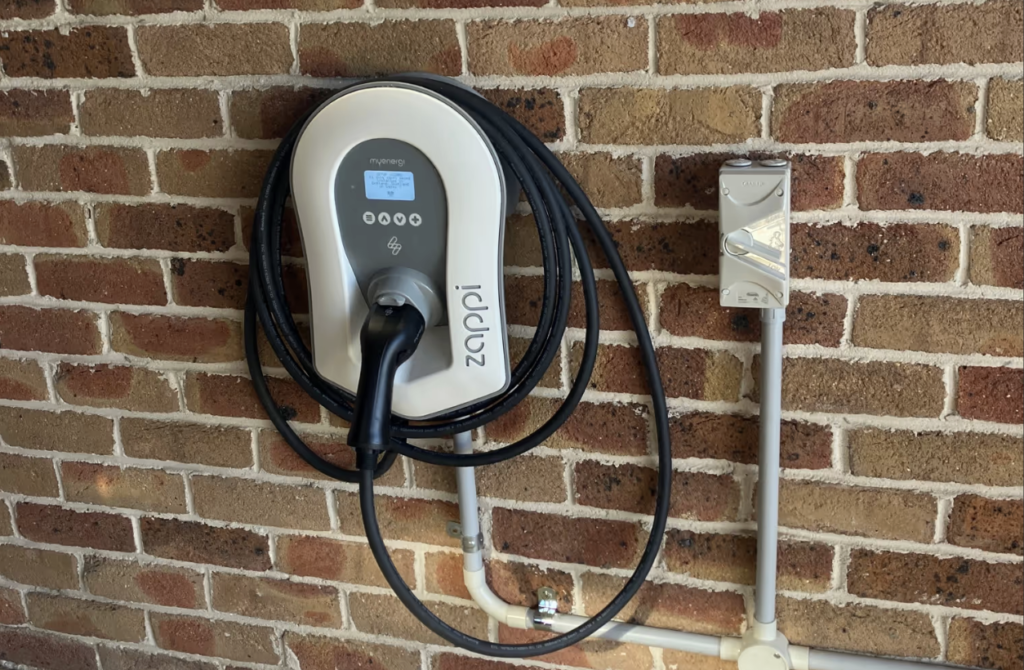
We recommended a Zappi or Evnex X22 — both integrate with third-party solar and battery systems and offer genuine dynamic load balancing, drawing from excess solar generation first and only pulling from the grid when output drops. The property also runs a three-phase supply, which both units support, so the switch doesn’t cost him charging speed. The install is scheduled and we’ll update this post with the outcome once it’s complete.
The take-home point: the EV charger and the EV itself don’t have to be the same brand, and if solar self-consumption matters to you, they often shouldn’t be. Brand matching feels intuitive but isn’t a technical requirement — what matters is whether the charger can actually talk to the rest of your system.
Compliance either way
Whichever charger you land on, AS/NZS 3000 Appendix P sets the baseline: every EV charging connecting point needs RCD protection, Type A as a minimum, with additional DC fault protection provided either as a genuine Type B RCD or a Type A RCD paired with an RDC-DD device (to IEC 62955) that disconnects supply if DC fault current exceeds 6mA. Zappi, Evnex, and the Tesla Wall Connector all meet this the same way, with built-in RDC-DD and integral Type A RCD — so compliance isn’t the deciding factor here. Solar and battery compatibility is.
The broader lesson for Hills District homeowners with solar
If you’re planning an EV charger install and you’ve already got solar or a home battery — Fox ESS, Sungrow, SolarEdge, or any system that isn’t the same brand as your car — ask your installer whether the charger you have in mind actually communicates with your existing system before you commit. It’s a five-minute question that can be the difference between a charger that works and one that does what you actually bought it for.
The same logic applies to a single-phase home with rooftop solar and no battery at all. In Box Hill, we recently installed a zappi GLO so a Tesla owner could charge from surplus solar without a Powerwall, on a dedicated 32A circuit with a CT clamp on the incoming mains. See our Box Hill zappi GLO case study for the full install detail and what it cost.
We check your existing solar and battery setup as standard on every EV charger quote across the Hills District and Hawkesbury. See our full EV charger installation page for brand comparisons and pricing, or our EV charger installation guide for the full process. If you’re weighing up Zappi specifically, our Zappi charging modes explained post covers Eco and Eco+ in detail. Note that the newer zappi GLO replaces those modes with a single smart charging toggle. For another real installation with its own site constraints, see our North Richmond detached garage case study.
Frequently Asked Questions
Does the Tesla Wall Connector work with a Fox ESS solar battery?
The Tesla Wall Connector will charge your vehicle, but it doesn’t natively communicate with Fox ESS or other third-party solar and battery systems. It charges on a fixed schedule from the grid rather than dynamically drawing from excess solar generation.
Can I use a non-Tesla EV charger with a Tesla vehicle?
Yes. Tesla vehicles charge from any compliant Type 2 EV charger, including Zappi, Evnex, Wallbox and Ocular. The charger brand does not need to match the vehicle brand, and for homes with existing solar or battery systems, a third-party smart charger is often the better fit.
Which EV charger works best with home solar in the Hills District?
Zappi and Evnex are the strongest options for solar self-consumption, both offering dynamic load balancing that prioritises excess solar generation over grid power. The right choice depends on your specific solar and battery brand, supply type, and switchboard capacity, confirmed during an on-site quote.