
The right EV charger for your home is decided by two things most buying guides never ask about: how fast your car can actually accept AC power, and whether your roof has solar on it. At Saunders Electrical Group, we’ve completed more than 70 EV charger installations across the Hills District and Hawkesbury — over half of them on homes with solar — and the most expensive mistake we see is buyers matching the charger to the brochure instead of the car in their driveway. We’re certified installers for myenergi Zappi, Evnex and Ocular, and we regularly install Tesla Wall Connectors, Sigenergy chargers and manufacturer-branded units from BYD and BMW. NSW Electrical Contractor Licence 344815C.
The short answer
- Home with solar: myenergi Zappi 7kW or Evnex E2 — both divert surplus solar straight into the car.
- Home with solar and a battery: Zappi configured so the house battery fills first — or, if you’re running a Sigenergy battery system, Sigenergy’s own charger keeps the whole decision inside one ecosystem. Details below, because most installers skip this.
- No solar, best value: Evnex E2 or Ocular IQ on a scheduled off-peak tariff.
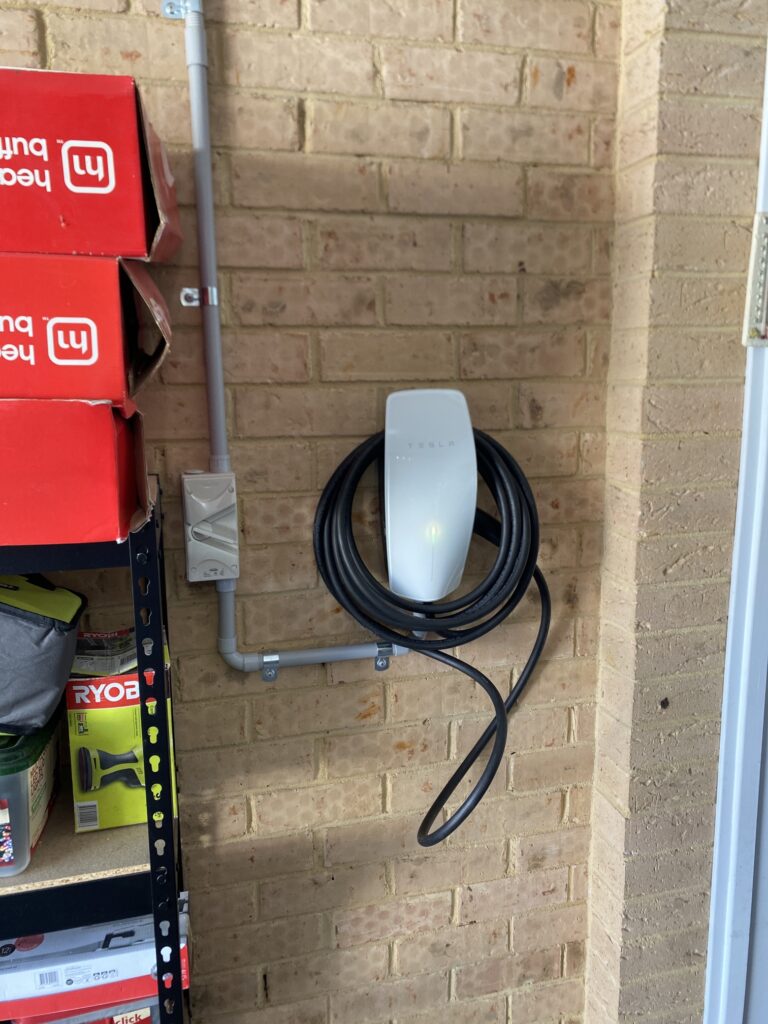
- Tesla, no solar: the Tesla Wall Connector — a unit we install regularly and rate highly for Tesla-only households. Add solar or a Sigenergy battery to the picture and the calculus changes, as we covered in our Tesla Wall Connector vs Zappi comparison from a Kellyville install.
- Three-phase home, 11kW-capable car, big daily kilometres: Zappi 22kW multiphase or an Evnex three-phase unit.
The reasoning — and the traps that catch most buyers — is below.
“Which charger is best?” is the wrong question
Every EV sold in Australia has an onboard AC charger with a hard speed limit, and no wall unit can push past it. A BYD Sealion 6 accepts a maximum of 6.6kW no matter what’s on the wall. Fit a 22kW three-phase charger to that car and you’ve paid for three-phase hardware, three-phase cabling and possibly a supply upgrade to charge at less than a third of the unit’s capacity. We’ve seen exactly this on quote visits in the Hills — a charger chosen off a spec sheet, delivering nothing the cheaper unit wouldn’t.
So the buying order is: car first, home energy setup second, charger brand last. Here’s how the popular models in our service area actually stack up.
Match the charger to your car
| Vehicle | Max onboard AC rate | What we’d fit |
|---|---|---|
| Tesla Model 3 / Model Y | 11kW (three-phase); 7.4kW on single-phase | Zappi 7kW for solar homes; Tesla Wall Connector if no solar and you’re staying Tesla-only |
| BYD Sealion 7 / Seal | 11kW | Zappi 22kW multiphase or Evnex three-phase if you have three-phase supply; otherwise 7kW single-phase |
| BYD Atto 3 / Dolphin | ~7kW | Zappi 7kW, Evnex E2 or Ocular IQ — a 7kW charger is this car’s ceiling |
| BYD Sealion 6 (PHEV) | 6.6kW | Smart 7kW unit. Three-phase hardware is wasted money on this car |
| BMW i4 / iX1 / iX | ~11kW | Three-phase unit if you have the supply and the kilometres; otherwise a 7kW smart charger covers overnight charging |
| MG4 / MG ZS EV | 6.6–7kW on most variants | 7kW single-phase smart charger |
| Hyundai Ioniq 5 / Kia EV6 | ~11kW | Three-phase worth considering for high-km drivers; 7kW covers overnight charging comfortably |
| Mitsubishi Outlander PHEV | ~3.7kW | Any quality 7kW smart charger has headroom to spare — solar diversion is where the value is |
| Nissan Leaf | 6.6kW | 7kW single-phase smart charger |
Onboard limits vary by variant and model year — these are the figures for current Australian-delivered models, and we confirm your exact vehicle’s limit at quote stage before recommending hardware.
The practical takeaway: a 7kW single-phase charger adds roughly 35–40km of range per hour and fills most EVs overnight. For the majority of Hills District homes and cars, that’s the right size. Three-phase only earns its cost when the car can take 11kW and you regularly need faster-than-overnight turnaround.
Should you just use the charger your dealer offers?
BYD and BMW both offer their own branded wallboxes, often bundled or discounted with the car — and we install plenty of them. Here’s the honest position from having commissioned both: they’re well-built grid chargers, they match the car’s onboard limit, and if your home has no solar and none planned, they’re a perfectly rational choice. What they don’t do is divert surplus solar. On a Hills District home with a 10kW array, that single missing feature is worth more per year than the bundle discount — you’d be exporting energy for a few cents that could be going into the car. Our rule on quote visits is simple: dealer charger for grid-only homes, solar-smart charger for everyone else, regardless of what badge is on the car.
Homes with solar: this is where the charger choice actually matters
More than half of the 70-plus EV charger installations we’ve completed across the Hills and Hawkesbury are on homes with solar — no surprise in an area where acreage blocks in Kenthurst, Annangrove and Glenhaven carry large north-facing arrays. On these homes, the charger’s solar intelligence matters far more than its maximum speed.
The myenergi Zappi remains the benchmark. Its Eco+ mode charges the car exclusively from surplus solar, throttling up and down in real time as clouds pass and household loads change — it needs around 1.4kW of surplus before it starts a session, which a typical Hills array clears for most of the day. We’ve broken down how the three modes work in our Zappi charging modes guide. The Evnex E2 achieves solar diversion via a CT clamp and pairs it with the longest warranty in its class. Ocular’s IQ solar models offer solar-assist modes at a sharper price point, and Sigenergy’s charger brings solar-aware charging to homes already running Sigenergy hardware. We install and service all of them, which means we’re recommending from what we’ve commissioned — not from a reseller margin.
Homes with solar and a battery: the question nobody’s answering
This is the fastest-growing install profile we’re seeing, and almost every buying guide ignores it. When your solar produces surplus, three things compete for it: the house battery, the car, and the grid export. The charger configuration decides who wins — and getting it wrong quietly costs you money.
Here’s the issue: a typical home battery holds 10–13.5kWh. Your EV holds 60kWh or more. If the charger is set up naively, it can pull the house battery down into the car — draining the small battery you bought for evening peak cover into a vehicle battery five times its size, paying round-trip conversion losses both ways.
“On battery homes we configure the CT metering so the charger treats battery discharge as household load, not surplus. The house battery fills first, the car takes genuine excess, and your battery cycles are saved for the evening peak they were bought for. It’s a ten-minute configuration decision that most installs skip.” — Oliver Saunders, Director, Saunders Electrical Group (Licence 344815C)
If your home runs a Sigenergy battery system, there’s a cleaner path again: Sigenergy’s own EV charger sits inside the same platform as the battery and inverter, so solar, battery and car charging are coordinated by one system instead of two brands negotiating through CT clamps. We’ve installed a good number of these and the single-ecosystem approach genuinely simplifies the priority problem.
One pairing to know about before you buy: the Tesla Wall Connector doesn’t support OCPP, the open protocol home energy platforms use to control third-party chargers — so a Sigenergy system can’t manage it. If you drive a Tesla and you’re planning a Sigenergy battery, choose the charger with that in mind, because it’s much cheaper to get right on day one than to swap hardware later.
If you’re getting quotes elsewhere, ask the installer how they’ll handle battery priority. If the answer is a blank look, keep looking.
No solar? Buy on tariff, not on speed
Without solar, the smart-charging value shifts to scheduling. A charger that reliably locks charging to your off-peak or dedicated EV tariff window does the financial heavy lifting — that’s a software feature, not a speed feature, and it’s why we’d point a grid-only home at an Evnex E2, an Ocular IQ, a Tesla Wall Connector for Tesla households, or the dealer’s own unit rather than paying a premium for solar intelligence you can’t use yet. If solar is on your two-year horizon (it usually is, out here), buy the solar-capable unit now and skip the second install.
What it costs, installed, in the Hills District and Hawkesbury
Chargers we supply start from $750 + GST, and installation starts from $850 + GST — so a straightforward single-phase install on a garage wall near the switchboard lands from around $1,600 + GST all-in. From 70-plus installs, these are the things that move the price beyond that:
- Detached garages and long cable runs — common on acreage. See our detached garage install at North Richmond for what’s involved.
- Switchboard remediation — older boards often need work before they can legally take a dedicated EV circuit.
- Three-phase installations — more cable, more protection, more labour.
- Surge protection — cheap insurance for a $1,000+ electronic device bolted to your wall.
- Cable management — tidy retention for tethered units.
Every install runs on a dedicated circuit with RCD protection as required by AS/NZS 3000:2018, and you receive a Certificate of Compliance for Electrical Work (CCEW) on completion. The full compliance picture is in our EV charger installation requirements guide, and timelines are covered in how long an EV charger installation takes.
Frequently asked questions
What EV charger should I buy for my car?
Match the charger to your car’s onboard AC limit first: most EVs in Australia accept 6.6–7kW, so a 7kW single-phase smart charger is the right buy for most drivers. Only cars that accept 11kW, on homes with three-phase supply, justify a three-phase unit.
Do I need a 22kW EV charger at home?
Almost certainly not. A 22kW charger only delivers its full rate if your car accepts 11kW+ AC and your home has three-phase supply — most Australian EVs cap at 6.6–7kW, and a 7kW charger fills them overnight.
What is the best EV charger for a home with solar?
The myenergi Zappi is the benchmark for solar homes because its Eco+ mode charges exclusively from surplus solar, and the Evnex E2 is a strong alternative with solar diversion and a long warranty. More than half of Saunders Electrical Group’s 70+ EV charger installs across the Hills District are on solar homes.
Should I use the EV charger that comes with my car?
Dealer-bundled chargers from brands like BYD and BMW are well-built grid chargers, and a rational choice for homes without solar. They generally can’t divert surplus solar into the car, so on a solar home a solar-smart charger like the Zappi or Evnex E2 recovers more value each year than the bundle saves upfront.
Should my EV charge from my home battery?
Usually no. A home battery holds 10–13.5kWh against an EV’s 60kWh+, so draining it into the car wastes the battery’s evening peak value and pays conversion losses twice. The charger should be configured to treat battery discharge as household load so only genuine solar surplus reaches the car.
How much does an EV charger cost installed in the Hills District?
Through Saunders Electrical Group, chargers start from $750 + GST and installation from $850 + GST — from around $1,600 + GST combined for a standard single-phase install. Detached garages, long cable runs, switchboard remediation and three-phase supply add to that.
Can any electrician install an EV charger?
EV charger installation in NSW must be done by a licensed electrician on a dedicated circuit with RCD protection under AS/NZS 3000:2018, with a Certificate of Compliance for Electrical Work issued on completion. Manufacturer certification also matters — warranty support is smoother when the installer is accredited for the brand.
Get the right charger, not the biggest one
Tell us your car, your solar setup and where the charger needs to go, and we’ll quote the unit that actually fits — backed by our lifetime workmanship guarantee. Visit our EV charger installation page or call 1300 993 560.