
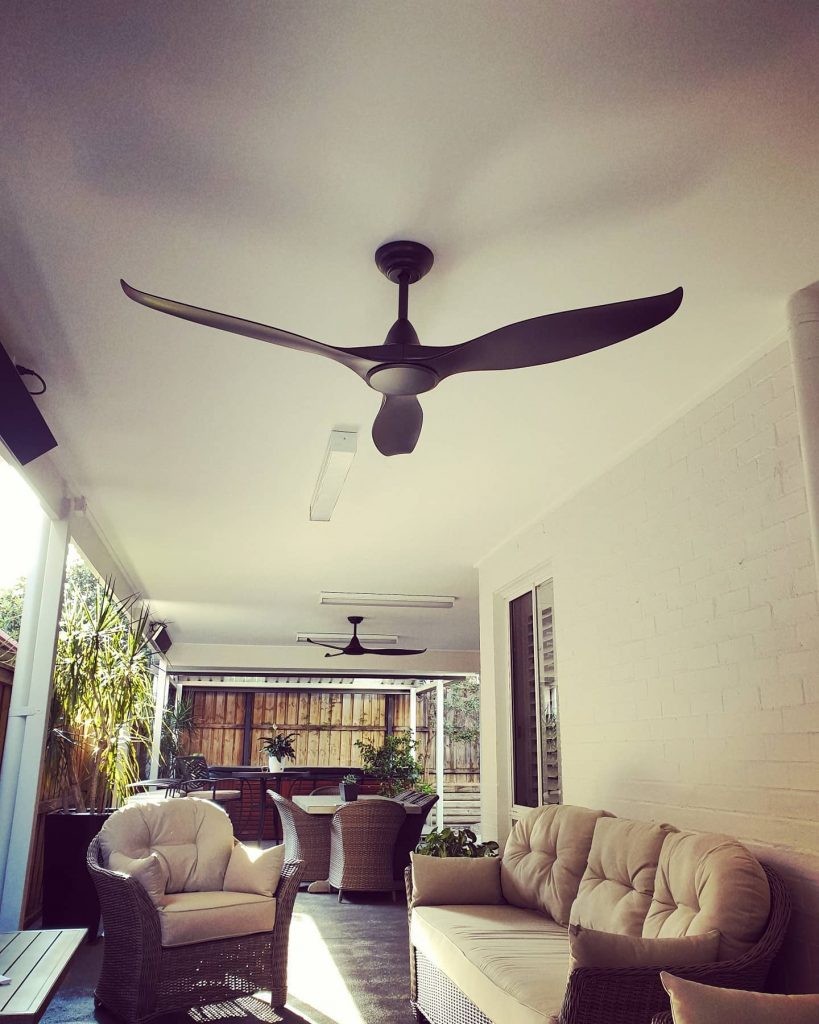
Ceiling Fan Installation Requirements — NSW & Hills District
Ceiling fan installation in NSW sits under two separate sets of requirements that are often blurred together: what the law requires, and what the fan manufacturer requires. Knowing which is which matters — one is non-negotiable regardless of what fan you buy, the other is set by the specific product you choose.
Legal Requirement: Licensed Electrician & Certificate of Compliance
Ceiling fan installation is prescribed electrical work in NSW under AS/NZS 3000:2018. This applies to every ceiling fan installation — new point, straight replacement, light-to-fan conversion, indoor or outdoor — regardless of the fan’s brand or motor type. It must be carried out by a licensed electrical contractor, and a Certificate of Compliance for Electrical Work (CCEW) must be issued on completion. Saunders Electrical Group holds NSW Electrical Contractor Licence 344815C, and issues a CCEW on every ceiling fan installation. An unlicensed installation isn’t covered by home insurance if something goes wrong, and doesn’t carry the CCEW you’d need for an insurance claim or when selling the property.
Manufacturer Requirement: Isolating Switch Per Fan
Every ceiling fan manufacturer’s installation instructions require a dedicated isolating switch for each fan installed. This isn’t an Australian Standard clause specific to fans — it’s a manufacturer requirement, consistent across brands, that allows a fan to be safely de-energised for servicing without cutting power to the rest of the circuit. If you’re adding fans to a home that doesn’t already have individual isolating switches per point, that’s a genuine line item in the quote, not an optional extra.
Manufacturer Requirement: Clearance Distances
Manufacturer installation instructions set two fixed clearance requirements that apply across the fans we install:
- Minimum 2.1m floor-to-blade clearance. In rooms with lower ceilings, this can rule out a full-size fan or push you toward a low-profile or hugger-style model.
- Minimum 300mm blade-to-wall clearance. Worth checking before settling on a fan for a tight corner or a wall close to a sloped section of ceiling.
These figures come from manufacturer installation instructions rather than a single Australian Standard clause specific to ceiling fans — worth knowing, since some installation guides online cite them as if they’re a direct AS/NZS 3000 requirement, which they aren’t.
Structural Requirement: What the Fan Is Fixed To
A ceiling fan is a continuous dynamic load, not a static one like a light fitting. Plasterboard alone can’t take that ongoing vibration — the mounting bracket has to be fixed to a timber joist, or to a timber block (noggin) fitted between joists if there isn’t one directly above the fixing point. This is the single most common shortcut on underpriced installs, since it takes longer on the tools than screwing straight into plasterboard, and the fault stays invisible until the fixing works loose. See our Stanhope Gardens case study for what that looks like when it’s missed.
Raked & Vaulted Ceilings
A raked ceiling needs a downrod and an angled mounting kit so the fan hangs vertically despite the ceiling’s pitch — a standard mount isn’t safe to use as-is, since the blades would sit at an angle and risk striking the ceiling. This is assessed and priced on site rather than quoted sight-unseen, since pitch and joist access vary property to property.
Outdoor & Pergola Fans
Fans installed outdoors or on covered pergolas need to be rated for the exposure — an appropriate IP rating on the fan itself, and a weatherproof-rated isolating switch rather than a standard indoor unit. Where the pergola or patio roof is insulated panel construction, there’s an additional cable requirement specific to that roof type — see our guide to wiring insulated pergola and patio roofs for that detail. Not every alfresco or outdoor fan needs a weatherproof switch, though — where the isolating switch itself is sited indoors (inside a back door, for example), a standard indoor-rated switch is fine, as it was on a recent 3-fan alfresco job in The Gables.
Light-to-Fan Conversions
Converting an existing downlight or pendant into a ceiling fan point isn’t a straight swap. A light fitting is supported on hardware rated for a static load — the existing point has to be assessed for whether it can take a fan-rated bracket, and upgraded to timber blocking if it can’t, before the fan goes up.
Saunders Electrical Group installs ceiling fans across the Hills District and Hawkesbury to every one of these requirements, on every ceiling type. Every job includes a Certificate of Compliance and our lifetime workmanship guarantee. Call 1300 993 560 for a fixed-price quote.
Related: Ceiling Fan Installation — Hills District & Hawkesbury · Ceiling Fan Buying & Installation Guide · Ceiling Fan Installation FAQ · DC vs AC Ceiling Fans: What Actually Matters · What a 3-Fan Alfresco Install Actually Costs — The Gables
Frequently Asked Questions
Do I legally need a licensed electrician to install a ceiling fan in NSW?
Yes. Ceiling fan installation is prescribed electrical work under AS/NZS 3000:2018, regardless of motor type, ceiling type, or whether it’s indoor or outdoor. It must be carried out by a licensed electrical contractor with a Certificate of Compliance issued on completion.
Is the isolating switch requirement an Australian Standard, or a manufacturer requirement?
It’s a manufacturer installation requirement, consistent across brands, rather than a specific Australian Standard clause for ceiling fans. Every manufacturer’s installation instructions require a dedicated isolating switch per fan.
Are the 2.1m and 300mm clearance figures a legal requirement?
They come from manufacturer installation instructions rather than a single fan-specific Australian Standard clause. Some online guides cite them as a direct AS/NZS 3000 requirement, which isn’t accurate — but they’re still fixed requirements you need to meet regardless of the source.
Do outdoor ceiling fans have different requirements to indoor ones?
Yes. Outdoor and pergola-mounted fans need an appropriately IP-rated fan and a weatherproof isolating switch. Fans on insulated panel roof pergolas also have an additional cable requirement specific to that roof type.