
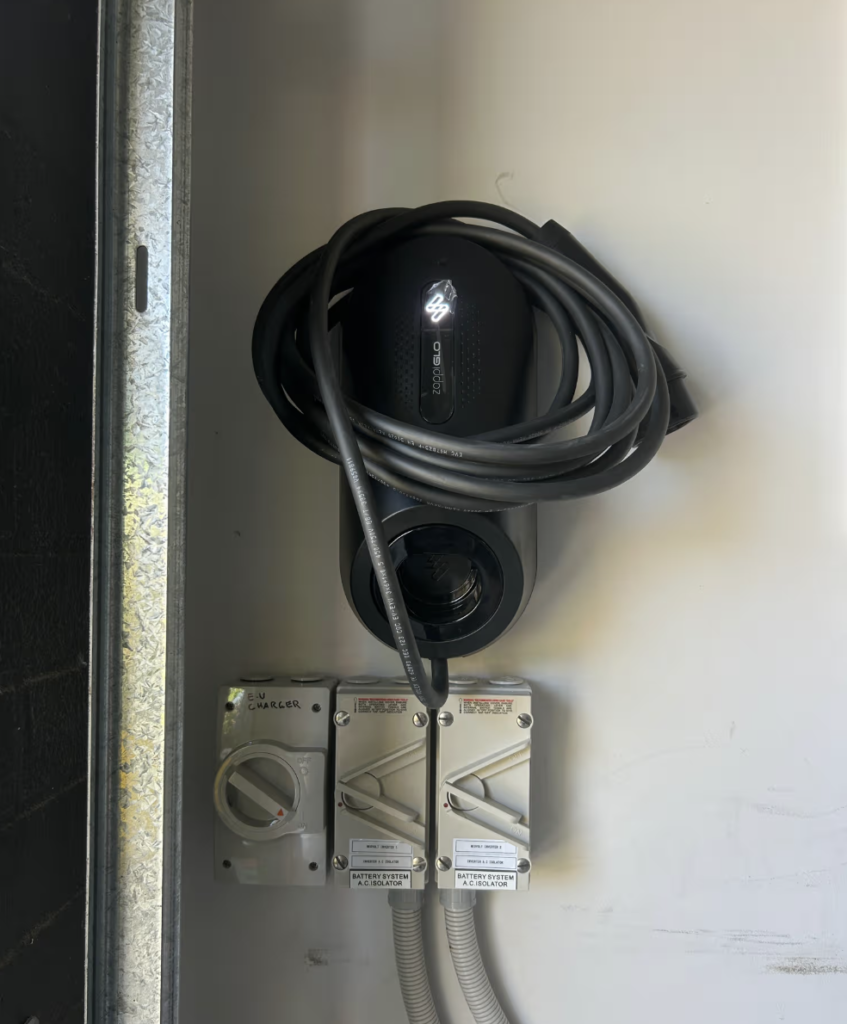
An EV charger has to sit at least 600 mm horizontally from a home battery, and it can’t be mounted within 900 mm above one. Those clearances come from the restricted-location rules in AS/NZS 5139, which treat an EV charger as an appliance that isn’t part of the battery system. We ran into this on a zappi GLO install in Box Hill in September 2026, where the spot the customer wanted was too close to their battery.
The Box Hill job: where the customer wanted it, and why it couldn’t go there
The customer already had solar panels and a home battery. They wanted the zappi GLO mounted under the window to the right of the battery. That position sat inside the battery’s clearance zone, so we couldn’t install it there.
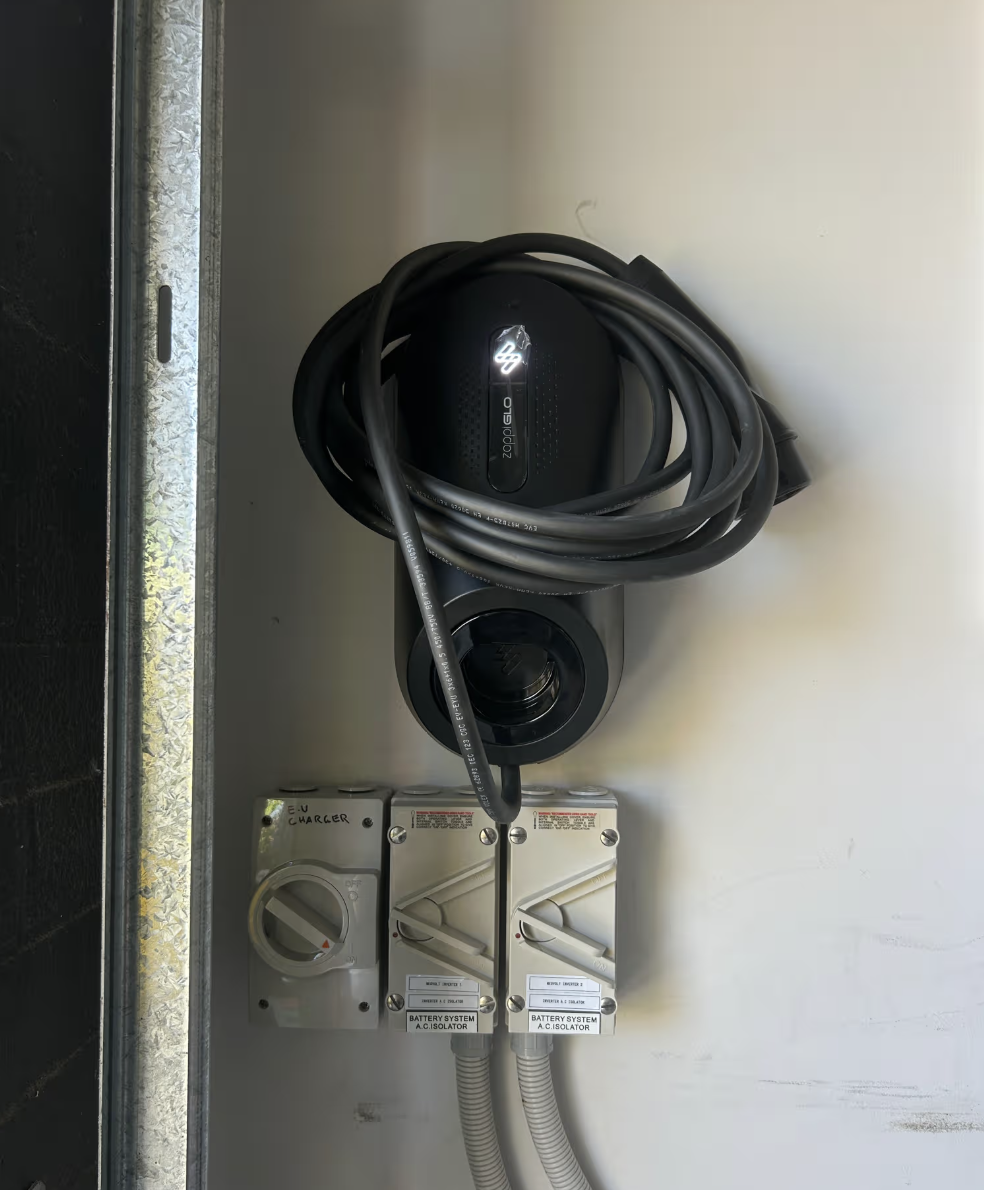
We mounted it just inside the garage roller door instead, about 650 mm to the left of the battery. That clears the 600 mm line. Moving the charger made no difference to the job’s time or cost.
What AS/NZS 5139 says about appliances near a battery
The clearance sits in clause 4.2.2.2 (restricted locations) for pre-assembled integrated battery systems, with a matching restricted-locations clause, 5.2.2.2, for pre-assembled battery systems. In plain terms:
- A battery can’t be installed within 600 mm horizontally of an appliance that isn’t associated with the battery system.
- A battery can’t be installed within 900 mm below such an appliance. For a charger, that means it can’t be mounted within 900 mm above the battery.
- An EV charger counts as one of those appliances. An inverter doesn’t, because Amendment 1 now classes inverters as associated appliances.
Amendment 1 to AS/NZS 5139:2019 was published on 19 December 2025 and, according to the NSW Building Commission advisory, it is mandatory in NSW. The advisory lists what changed, and a new appliance clearance isn’t on it. It does list other location changes, such as batteries now being allowed within 600 mm of an opening wider than 900 mm, like a garage door. If you’re reading a guide written before 2026, check that it reflects the amendment.
The battery and charger manufacturers’ installation instructions can add their own clearances. The stricter requirement wins.
Why the charger moves, not the battery
The standard is written as a rule about where a battery can go. When solar and a battery are installed together, the battery installer plans around it. On an EV charger retrofit the battery is already on the wall, so the charger has to fit around a zone the battery already owns. Most of what we found online is written from the battery installer’s side, which is why the charger side rarely gets covered.
In our experience, roughly one in ten of our EV charger installs needs us to plan around a battery this way.
Before you book an EV charger install with solar and a battery
- Tell us where the battery is and where you’d like the charger. A photo of the wall and garage is enough for us to check it.
- Expect us to measure from the battery, not from the switchboard or the car space.
- If your first-choice spot fails, we’ll propose a compliant one. At Box Hill it was a different position in the same garage.
Also see our 3-phase zappi install in Box Hill with solar and a battery, the switchboard and site requirements for an EV charger install, and our EV charger installation FAQ.
Read more about EV charger installation in the Hills District, our EV charger installation guide, or our electricians in Box Hill. Another Box Hill job: a zappi GLO installation for a Tesla on solar.
Saunders Electrical Group, NSW Contractor Licence 344815C.
Frequently asked questions
How far does an EV charger need to be from a home battery in NSW?
At least 600 mm horizontally, and not within 900 mm above the battery. These come from the restricted-location rules in AS/NZS 5139, which Amendment 1 (mandatory in NSW) left in place for appliances.
Does the 600 mm rule apply to EV chargers?
Yes. An EV charger is an appliance that isn’t part of the battery system, so it has to stay outside the battery’s clearance zone.
Can an EV charger be installed directly above a home battery?
Not within 900 mm. The rules keep a battery out of the 900 mm zone below an appliance, so a charger can’t be mounted within 900 mm above one.
Can an inverter be next to a home battery when a charger can’t?
Yes. Under Amendment 1 an inverter is classed as an associated appliance and is allowed within the restricted location. An EV charger is not associated with the battery system.