
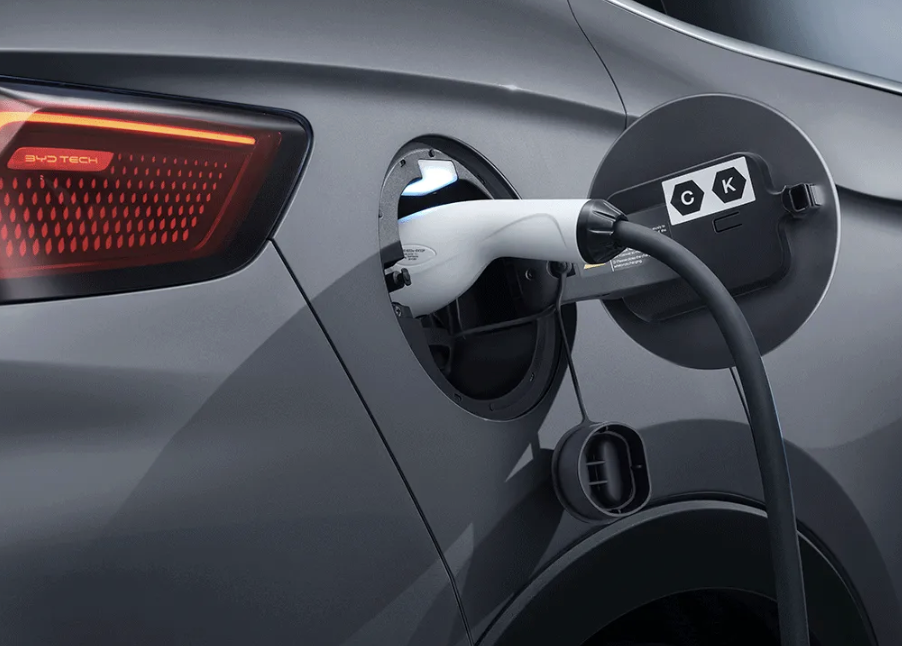
If your BYD Sealion is charging slowly on the cable that came with the car, the charger isn’t the problem — the car is. Every BYD Sealion has a built-in limit on how fast it can accept AC power, and the portable charger BYD supplies is rated well below that limit. Saunders Electrical Group (Electrical Contractor Licence 344815C) is a certified myenergi Zappi and Evnex installer working across the Hills District and Hawkesbury, and this is one of the most common questions we get from new BYD owners before they’ve had a dedicated charger installed.
Sealion 6 and Sealion 7 Aren’t the Same Type of Car
A lot of the confusion in local BYD owner groups comes down to one thing: the Sealion 6 and Sealion 7 aren’t variants of the same car — they’re two different kinds of vehicle wearing similar badges.
- BYD Sealion 6 is a plug-in hybrid (PHEV). It has an 18.3 kWh battery, roughly 80–92 km of pure electric range, and a 1.5-litre petrol engine that takes over once the battery’s depleted. You’ll still be buying fuel — just a lot less of it.
- BYD Sealion 7 is a full battery-electric SUV (BEV). Depending on the variant, it has a 71.8–91.3 kWh battery and no petrol engine at all. This is the one where “switching to EV” actually means switching, fully, off fuel.
That distinction matters for everything that follows — the charging math and the savings math are genuinely different for each car, not just different trim levels of the same math.
Why the Supplied Charger Feels So Slow
Both the Sealion 6 and Sealion 7 have an onboard AC charger that caps how fast they can accept power — 7 kW on single-phase power for both models (the Sealion 7 can step up to 11 kW if your home has three-phase power). That’s the ceiling, no matter what charger you plug in.
The portable charger BYD includes in the boot is designed for occasional use, not daily overnight charging. It typically runs at 1.8–2.3 kW from a standard 10 A wall socket — around a third of what the car can actually accept. That’s why a full charge on the supplied cable can take 20+ hours, while the same battery on a correctly installed 7 kW wall charger takes closer to 3–10 hours depending on battery size and starting charge.
The fix isn’t a faster charger — it’s the right one, on the right circuit. A 22 kW three-phase charger will not charge either Sealion faster on single-phase power, and even on three-phase, the Sealion 6 still caps at 7 kW — only the Sealion 7 can use the extra capacity. Buying above your car’s onboard limit is money spent on a spec you can’t use. We’ve covered the switchboard and circuit requirements behind a compliant EV charger install in detail in our EV charger installation requirements guide, and the full cost breakdown in our EV charger installation guide.
What You’d Actually Save Switching to a BYD Sealion 7
This is the question we see asked far more often than it’s actually answered with real numbers. Here’s the honest calculation, using published 2026 rates rather than a rounded-up guess — plug in your own annual kilometres and electricity plan for a figure specific to your household.
The comparison, for a typical 15,000 km/year Hills District commute:
- Petrol equivalent (mid-size SUV, ~8 L/100km): 1,200 litres/year × current Sydney average unleaded price (~$2.00/L as of August 2026, per NRMA and ACCC fuel price monitoring) ≈ $2,400/year
- BYD Sealion 7 (real-world ~18 kWh/100km, per independent 30,000 km owner testing): 2,700 kWh/year
- On a standard flat electricity rate (~30c/kWh): ≈ $810/year
- On a dedicated EV/off-peak electricity plan (7–15c/kWh overnight, available from several NSW retailers on the Ausgrid and Endeavour Energy networks in 2026): ≈ $190–$405/year
- Charged from excess solar during the day: close to $0 for that portion of driving
That puts realistic annual fuel-cost savings for a Sealion 7 owner somewhere between roughly $2,000 and $2,200 a year, before servicing — and the gap widens further with a solar-integrated smart charger like the myenergi Zappi, which we cover in our Zappi charging modes guide.
On top of fuel, EVs typically carry lower scheduled servicing costs — no oil changes, fewer moving parts in the drivetrain, and regenerative braking that reduces brake pad wear. We don’t have SEG-specific servicing data to quote yet (it’s not something we track on the electrical side of the job), so treat that as directionally true rather than a number — your dealer’s service schedule will give you the real comparison.
For a Sealion 6 owner, the picture is smaller but still real: most daily driving happens in the ~80–92 km EV-only range, so you’re mainly saving on the fuel you’d otherwise burn on short trips — worth having a proper 7 kW charger for, but not a full fuel-bill elimination.
Doing It Properly, Not Just Quickly
Under the NSW Electricity (Consumer Safety) Act, connecting a dedicated EV charging circuit is prescribed electrical work — it has to be done by a licensed electrician, with a Certificate of Electrical Compliance issued on completion, or your home insurance and the charger’s own warranty can be at risk. We cover exactly why in our guide to licensed EV charger installation in NSW.
Saunders Electrical Group installs EV chargers for both PHEV and full-EV BYD owners across Kenthurst, Castle Hill, Baulkham Hills, Kellyville, Rouse Hill, Windsor, Richmond and the surrounding Hills District and Hawkesbury suburbs. See our EV charger installation service page for a free quote.
Frequently Asked Questions
Is the BYD Sealion 6 the same car as the Sealion 7?
No. The Sealion 6 is a plug-in hybrid with a petrol engine and roughly 80–92 km of electric range. The Sealion 7 is a full battery-electric SUV with no petrol engine. They have different batteries, different charging profiles, and different fuel-savings outcomes.
Will a faster wall charger make my BYD Sealion charge quicker?
No, beyond 7 kW on single-phase power. Both Sealion models cap their AC charging at 7 kW on a single-phase supply — only the Sealion 7 can use up to 11 kW if the home has three-phase power. A higher-rated charger won’t push more power into the car than its onboard charger allows.
How much can I save switching from a petrol SUV to a BYD Sealion 7?
Based on 2026 fuel and electricity rates, a typical 15,000 km/year driver could save roughly $2,000–$2,200 a year on running costs alone, before servicing savings — more if charging on an EV electricity plan or home solar.
Do I need a licensed electrician to install a home charger for a BYD Sealion?
Yes. Connecting a dedicated EV charging circuit is prescribed electrical work under NSW law and must be carried out by a licensed electrician with a Certificate of Electrical Compliance issued on completion.