
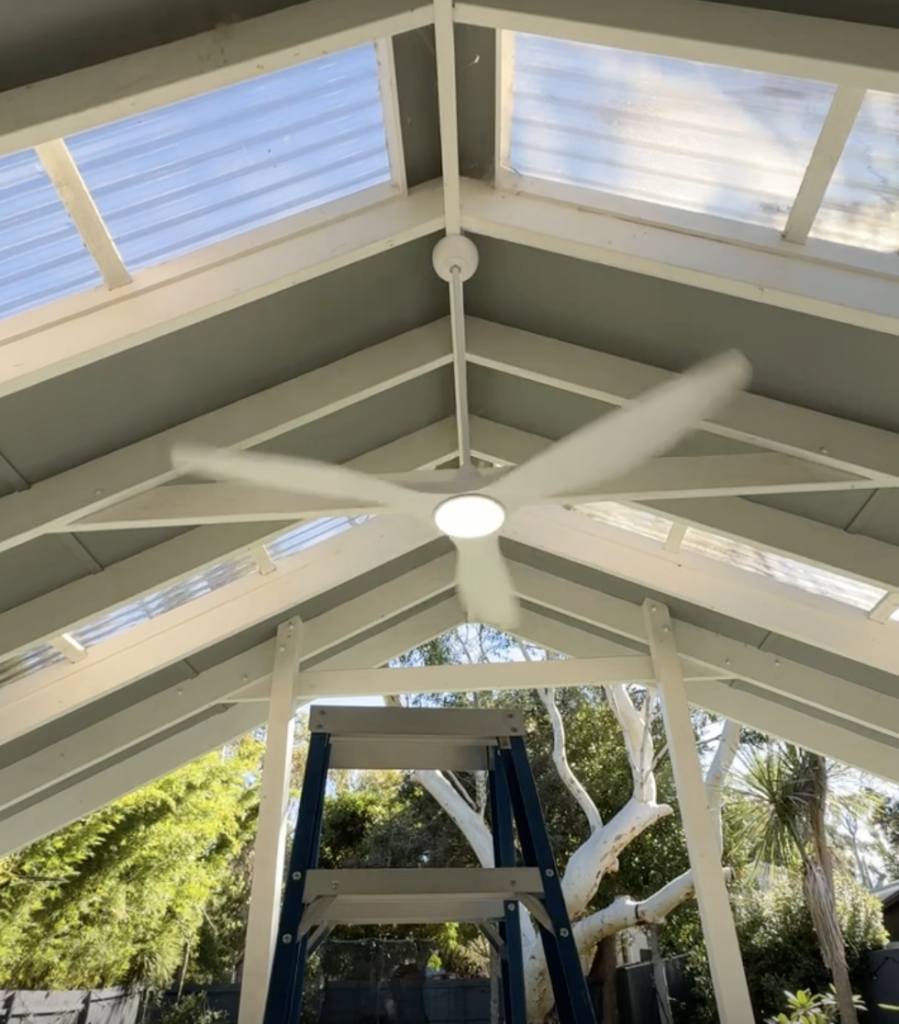
A ceiling fan that suddenly stops working a few weeks after installation isn’t always a faulty fan. Saunders Electrical Group was called to a property in Annangrove where a ceiling fan on a pitched pergola ceiling, fitted with an extension rod, had stopped working shortly after being installed by another contractor. The cause wasn’t the fan itself — it was a single pin that had popped out of the wiring loom connector inside the extension rod.
Why an extension rod is a hidden point of failure
Ceiling fans on pergolas, patios, and pitched or raked ceilings often need an extension rod to bring the fan down to the correct height — the same scenario covered in our Ceiling Fan Buying & Installation Guide. Inside that rod runs a wiring loom — a plug-and-socket style connector joining the wiring from the fan motor above to the wiring going into the ceiling bracket below. It’s fitted, the rod is slid into place, and from the outside the whole thing looks like a single solid assembly.
What’s easy to miss is that the wiring loom connector inside the rod is still just a plug. If one of the individual pins in that plug isn’t fully seated when the rod is assembled — or works loose slightly during handling or installation — the fan can appear to install and test correctly, then fail once it’s been up and running for a period. This is a fault that sits entirely out of sight once the rod is fitted, which is exactly why it gets missed.
What we found in Annangrove
The customer’s fan had stopped working a couple of weeks after the original installation, and the electrician who’d fitted it wasn’t returning their calls. On inspection and testing, we traced the fault to one popped pin inside the wiring loom connector, inside the extension rod. We reseated the pin, the connection was restored, and the fan worked immediately — no replacement fan, no replacement parts, no further wiring fault anywhere else in the circuit.
This isn’t a one-off. We’ve encountered this specific fault a number of times on extension rod installations. It’s not widely recognised as a common cause of fan failure, and in our experience it’s not the first thing checked when a fan on a rod stops working.
Why this matters for diagnosis, not just the fix
When a ceiling fan stops working, the instinctive assumption is that the fan itself has failed — a motor fault, a capacitor issue, or a component that needs replacing. On an extension rod installation, that assumption can lead to a customer being quoted for a new fan or new parts when the actual fault is a single disconnected pin inside the rod, fixable in minutes. Before advising a client they need a new fan or replacement parts, the wiring loom connection inside the rod should be checked first if the fan is mounted on an extension rod.
How to prevent it
The fix during installation is straightforward: taping the wiring loom plug connection securely once it’s seated inside the extension rod, so it can’t work loose or partially disconnect during handling or over time. This is now standard practice on our own extension rod installations.
Saunders Electrical Group installs and troubleshoots ceiling fans across the Hills District and Hawkesbury, including fans on pergolas, patios, and extension rod installations. Every installation includes a Certificate of Compliance. Call 1300 993 560 for a fixed-price assessment.
Related: Ceiling Fan Installation — Hills District & Hawkesbury · Ceiling Fan Buying & Installation Guide · Ceiling Fan Installation FAQ · Why Your Ceiling Fan Wobbles — And Why It’s Rarely the Fan’s Fault
Frequently Asked Questions
Why would a ceiling fan on an extension rod suddenly stop working?
One common but under-recognised cause is a disconnected pin inside the wiring loom connector within the extension rod itself. If a pin isn’t fully seated or works loose after installation, the fan can fail without any fault in the fan motor or the rest of the circuit.
Does a ceiling fan on a pergola need an extension rod?
Often, yes, particularly on pitched or raked pergola ceilings, where an extension rod brings the fan down to the correct height for effective airflow.
If my ceiling fan stops working, does it mean it needs to be replaced?
Not necessarily. On extension rod installations, a stopped fan can be caused by a loose connection inside the rod’s wiring loom rather than a fault in the fan itself. This should be checked before assuming the fan or its parts need replacing.
Can a loose wiring connection inside an extension rod be fixed without replacing the fan?
Yes. In cases where the fault is a disconnected pin in the wiring loom, reseating the connection restores the fan to full working order with no replacement parts required.
How can this fault be prevented during installation?
Taping the wiring loom plug connection securely once it’s seated inside the extension rod prevents it from working loose during handling or over time. This is standard practice on Saunders Electrical Group’s own extension rod installations.